The ISO 27001 Evidence Your Engineers Shouldn't Be Screenshotting
The ISO 27001 Evidence Your Engineers Shouldn't Be Screenshotting
An engineer opens the AWS console, screenshots an IAM policy, drops it in a shared drive, and gets back to work. Multiply that by 50 controls, three cloud accounts, and a twelve-month observation window, and you've built the least reliable evidence system possible, one that depends on a human remembering to take a picture at the right moment, every month, for a year.
ISO 27001 requires evidence that controls operate consistently over time. Screenshots prove a control existed at 2:47 PM on a Tuesday. They prove nothing about the other 364 days.
Here's what should never touch a screenshot — and what to do instead.
Why are screenshots the wrong evidence model?
A screenshot is a point-in-time artifact. ISO 27001 recommends maintaining at least twelve months of logs to demonstrate control effectiveness over time. A single image can't do that. It shows a config that was correct once. It says nothing about drift, about the week someone disabled MFA to debug something and forgot to re-enable it, or about the access review that got skipped in month seven.
Auditors know this. A folder full of screenshots dated the week before the audit reads as exactly what it is: evidence gathered for the auditor, not evidence generated by an operating control. That distinction matters more than most teams realize.
Which evidence categories should never be manual?
- Access control logs. Who has access to what, and when did that access change? This data lives in your identity provider. Pulling it via API gives you a complete, timestamped record. A screenshot of a permissions page gives you one moment, manually captured by someone who might have missed a role that was added an hour earlier.
- Cloud configuration state. Encryption settings, security group rules, logging configuration, network architecture. These change constantly as infrastructure evolves. An engineer screenshotting an S3 bucket policy today says nothing about whether that policy held for the following ten months. Automated scanning catches drift the moment it happens.
- Vulnerability scan results.
Scan output needs to show what ran, when, what was found, and how it was remediated, across the entire observation window. A handful of screenshots from scan reports can't reconstruct a remediation timeline. Structured export from your scanning tool can.
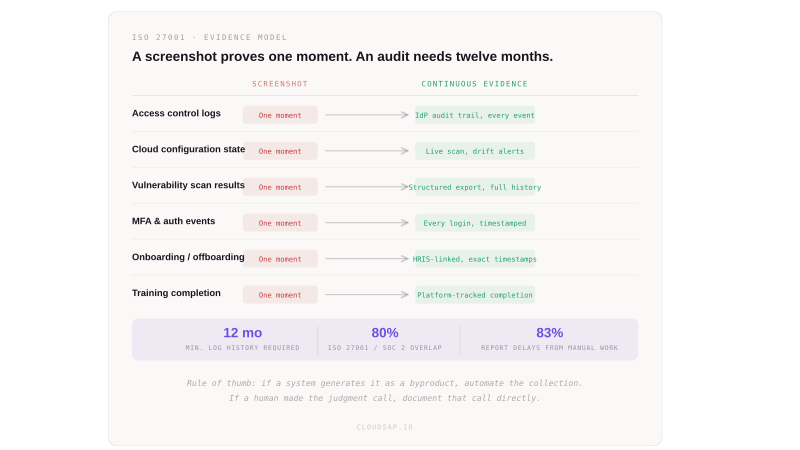
- MFA and authentication events. Whether MFA was enforced isn't a single fact. It's a continuous state that can lapse. Identity provider logs capture every authentication event with a timestamp. A screenshot captures the settings page as it looked once.
- Employee onboarding and offboarding records. When someone joins, when their access gets provisioned, when they leave, when access gets revoked. This needs to tie directly to HR system timestamps. A screenshot of a termination email doesn't prove access was actually revoked, or when.
- Training completion. Who completed security awareness training, and when. Training platforms track this natively with timestamps and completion rates. Screenshotting a spreadsheet someone updates by hand introduces exactly the kind of gap an auditor is trained to spot.
- Vendor and subprocessor evidence.
Current
SOC 2 reports, security questionnaire responses, contract terms. These should live in a structured vendor register with expiration tracking, not a folder of scanned PDFs with no renewal alerts.
What should replace the screenshot?
- API-based evidence collection. Compliance platforms connect directly to your cloud providers, identity provider, HR system, and code repositories. They pull structured data — not images — and map it to specific controls. When an auditor asks for proof that access reviews happened quarterly, the platform shows four dated, timestamped review records. Not four screenshots someone remembered to take.
- Continuous controls monitoring. Instead of checking a control once before the audit, automated monitoring checks it constantly. If encryption gets disabled on a database at 3 AM on a random Thursday, the monitoring catches it that day. A screenshot taken during audit week would have shown a green checkmark and missed the gap entirely.
- System-generated logs. SIEM platforms, cloud-native logging (CloudTrail, Azure Monitor, GCP Cloud Logging), and identity provider audit trails generate evidence as a byproduct of the system running. This evidence exists whether or not anyone remembers to collect it.
We help you prepare for
ISO 27001 certification in 4-8 weeks.
What should stay manual?
Not everything can be automated, and pretending otherwise creates its own risk.
- Physical security evidence. Badge access logs, visitor sign-ins, clean desk audits. If you have office space, this evidence is inherently manual and needs a documented collection cadence.
- Risk assessment reasoning. The risk register can be templated, but the actual reasoning — why you prioritized certain threats, why you chose specific treatment plans — comes from human judgment. Document it directly rather than trying to force it into an automated evidence pipeline.
- Management review minutes. ISO 27001 requires documented evidence that leadership reviewed the ISMS at planned intervals. This is a real meeting with real decisions. Capture it as structured meeting notes, not a photo of a whiteboard.
- Policy exceptions and justifications. When you exclude a resource from a control or accept a specific risk, the reasoning needs a written record. This is deliberate documentation, not evidence a system generates on its own.
The rule of thumb: if a system produces the fact as a byproduct of operating, automate its collection. If a human made a judgment call, document that judgment directly instead of screenshotting evidence of the decision.
What does this actually save?
Manual evidence collection for a first-time SOC 2 or ISO 27001 audit typically takes six to nine months, and a large share of organizations report moderate to major delays tied directly to manual collection work. Automated collection compresses that dramatically — not because the framework requirements shrink, but because nobody is manually reconstructing twelve months of history in the final week before fieldwork.
There's a compounding benefit too.
ISO 27001 and SOC 2 share roughly 80% overlapping control requirements.
Automated platforms map a single piece of evidence — an MFA enforcement log, an encryption configuration — to multiple framework controls simultaneously. Collect once, apply everywhere. Manual screenshot-based collection can't do this. Every framework becomes a separate folder of separate screenshots, even when the underlying control is identical.
How do I make the switch without a rebuild?
Start with the highest-volume, highest-risk categories first: access control and cloud configuration. These generate the most audit findings and the most screenshot fatigue. Connect your identity provider and cloud accounts to a compliance platform, let it run for a full cycle, and compare the evidence it produces against what your team was manually gathering before.
Then expand to vulnerability scanning, training records, and vendor management. Keep physical security and judgment-based documentation as structured manual processes — automating those poorly creates worse evidence than doing them well by hand.
The bottom line: Screenshots feel like evidence because they're visual and immediate. They're actually the weakest form of proof ISO 27001 accepts — a single frame standing in for twelve months of continuous operation. The controls that matter most to your ISMS are exactly the ones that should never depend on an engineer remembering to take a picture.
Ready to move faster?
Too much to do,
too important to ignore.
Start with a 30-minute discovery call. If we're not the right fit, we'll tell you and point you in the right direction. If we are, we'll leave the call with a clear plan to get you up and running.