SOC 2 Type I vs Type II: Which One Gets You Through Enterprise Procurement Faster?
SOC 2 Type I vs Type II: Which One Gets You Through Enterprise Procurement Faster?
TL;DR
- Type I checks whether your controls are properly designed on a specific day. It usually takes 3 to 6 months end to end.
- Type II checks whether those controls actually worked over 3 to 12 months. It usually takes 6 to 12 months for a first report.
- Most enterprise buyers want Type II. If the questionnaire says Type II, a Type I won't satisfy it.
- Type I is faster to get and works as a bridge for smaller or earlier deals, as long as you also give the buyer a date for your Type II.
- The fastest route for most SaaS companies is to start the Type II observation window as early as possible, and use a Type I or a readiness letter to cover the gap.
Your champion at the enterprise account is ready to sign. Legal has stopped redlining. Then procurement sends over the vendor onboarding form, and question 4 asks for "a copy of your current SOC 2 report."
You don't have one. You Google "SOC 2" and find out there are two types, and that the internet disagrees about which one you need and how long each takes.
This post answers the questions founders and sales leaders ask us most when they hit that wall.
What is the difference between SOC 2 Type I and Type II?
Both are reports from a licensed CPA firm, and both test you against the same Trust Services Criteria. The difference is time.
- A Type I report looks at your controls on a single date and asks whether they are designed properly. Think of it as a photo of your kitchen the morning the inspector visits. Everything is wiped down and the knives are in the block.
- A Type II report looks at the same controls over an observation period, usually 3 to 12 months, and asks whether they actually worked the whole time. That one is closer to a camera in the kitchen for six months.
The auditor will notice the Friday you skipped the access review, and the new hire who got admin rights before finishing onboarding.
That difference explains why buyers treat them so differently. A Type I tells them you have a plan. A Type II tells them you followed it.
How long does each one take?
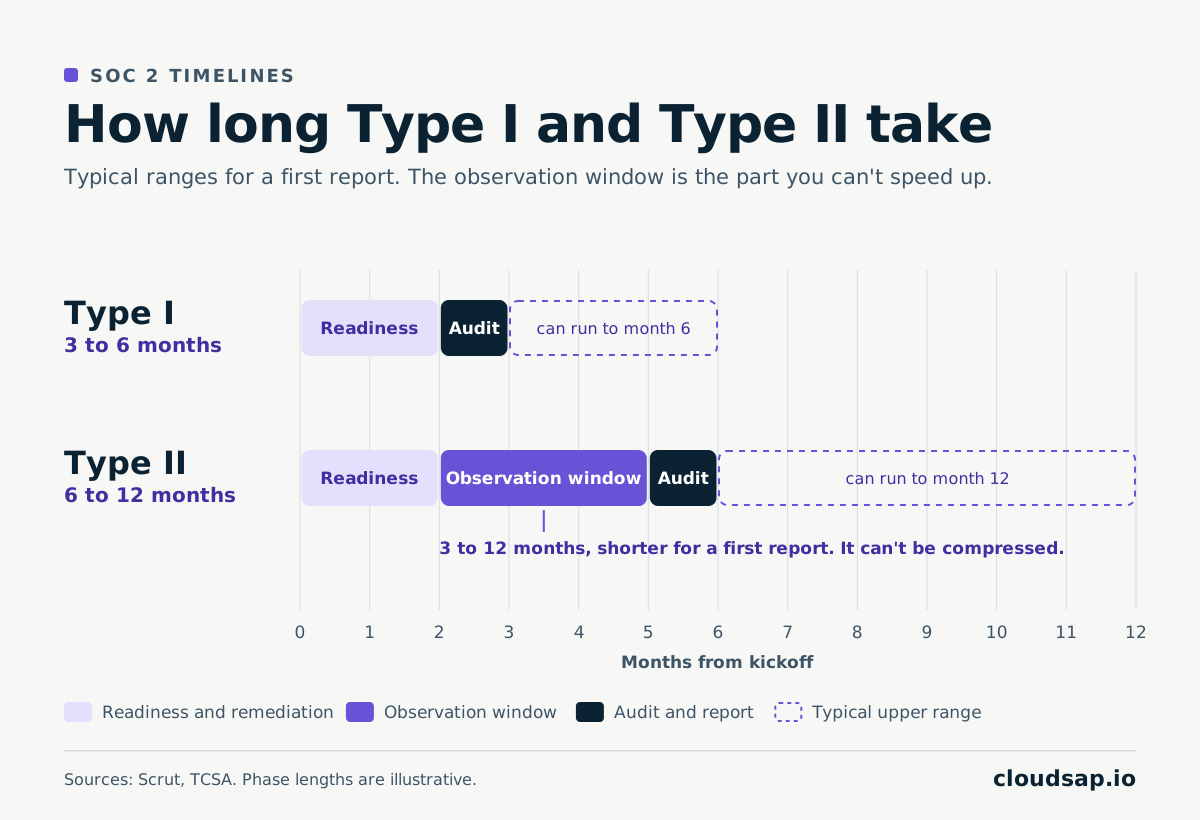
For a first report, plan on 3 to 6 months for Type I and 6 to 12 months for Type II. The biggest factor is how ready your controls are on day one.
Both paths start the same way:
- Readiness and gap assessment. You find out what's missing. This is where most teams discover the spreadsheet of user access that hasn't been updated since the office had a ping-pong table.
- Remediation. You write the policies, turn on MFA everywhere, set up access reviews and fix whatever the gap assessment found.
- Audit. For Type I, the auditor tests the design on one date and writes the report.
Type II adds an observation window between remediation and the audit, which usually runs 3 to 12 months. You can't speed it up. A three-month window lasts three months, however many people you put on it. Most companies pick a shorter window for their first report, which is how they land in the 6 to 12 month range. Pick a 12-month window and the whole project runs past a year. That window is why Type II takes longer, and it's also why buyers trust it more.
Most delays happen before the window starts. Common ones are evidence nobody can find, a scope nobody agreed on, and an engineering team that has been "getting to the MFA thing" since spring.
Which one do enterprise buyers accept?
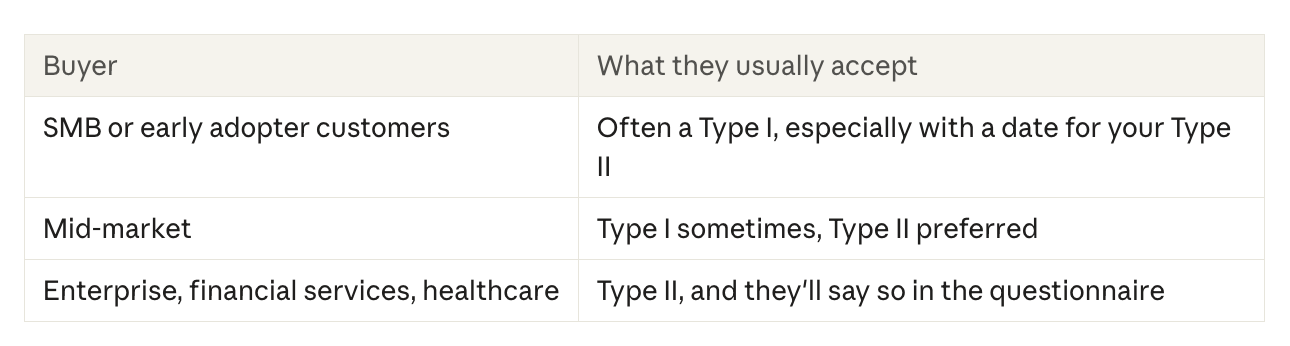
Most large enterprise buyers ask for Type II, and their security reviewers will check which one you sent.
It depends on who you are selling to:
So which one gets you through procurement faster?
It depends on what the buyer asked for.
Go with Type I first if:
- You are early stage and chasing your first enterprise deal.
- The buyer has said a Type I is acceptable for now.
- You need something in hand within a quarter.
Go straight to Type II if:
- The questionnaire or contract says Type II.
- You sell to enterprise, financial services or healthcare.
- You have more than one big deal in the pipeline, because they will all ask for the same thing.
For most SaaS companies, the faster route combines the two. Start the Type II observation window as early as you can, and use a Type I or a readiness letter to answer buyers while the window runs. That way, the clock you can't speed up is running in the background while sales keeps moving.
We help you set up Vanta,
Drata and Thoropass in 6 - 10 weeks.
Is doing Type I first a waste of money?
Sometimes. It depends on whether the Type I helps you close a deal.
One 2026 pricing guide puts specialist auditor fees at $12K to $40K for Type I and $15K to $75K for Type II. If you do both, you pay for two audits. The same guide says that if you move from Type I to Type II within 12 months, most auditors credit 40% to 60% of the Type I fee. Ask about this before you sign the engagement letter, not after.
A Type I is worth it when it unblocks revenue now. If a $150K contract is waiting on a report and the buyer will take a Type I, the audit fee looks small. If no buyer has asked for a Type I, you're paying for a report that will sit in a folder until your Type II replaces it.
What if the deal closes next month and I have neither?
You can't get a Type II in a month, and in most cases you can't get a Type I either. What you can do is give procurement enough to keep the deal moving:
- A readiness or gap assessment letter. It shows where you stand against SOC 2 and what's left to fix, signed by whoever ran the assessment.
- A signed engagement letter with your auditor. This proves the audit is booked and gives the buyer a real date.
- A filled-in security questionnaire. Answer it honestly. "In progress, target date March" is better than a "yes" you'll have to walk back.
- A call with your security lead. Reviewers relax when they can talk to someone who knows the systems.
- A contract clause. Some buyers will sign if you commit to delivering the report by a set date.
None of these will satisfy a buyer who requires a Type II before signing. They can move a deal from "no" to "yes, subject to the report," which is often enough.
FAQs
Can I skip Type I and go straight to Type II? Yes. Many companies do, especially when their buyers already require Type II. You'll need to be confident your controls are ready before the observation window starts, because problems found during the window end up in the report.
How long is a SOC 2 report valid? There's no official expiry date. In practice, buyers expect a report that covers a period ending within the last 12 months, which is why Type II becomes a yearly cycle.
What is a bridge letter? A letter from your company covering the time between the end of your last audit period and today. It says nothing material has changed. Buyers often ask for one when your report is a few months old.
Can my observation window be shorter than 3 months? Some auditors will accept a shorter window for a first report. Buyers may question a very short one, so check what your key customers expect before you choose.
Does a Type I count as "SOC 2 compliant"? You have a SOC 2 report, so technically yes. Just don't present a Type I as if it were a Type II. Reviewers will notice, and you'll lose the trust you need for the rest of the deal.
Which Trust Services Criteria do I need? Security is required. Most SaaS companies add Availability, and some add Confidentiality. Add Processing Integrity or Privacy only if your buyers ask for them.
Not sure which SOC 2 report your next deal needs?
Book a free 45-minute gap analysis with CloudSapio. We'll look at where you stand today, tell you whether Type I or Type II fits your pipeline, and give you a realistic date you can share with procurement.
Ready to move faster?
Too much to do,
too important to ignore.
Start with a 30-minute discovery call. If we're not the right fit, we'll tell you and point you in the right direction. If we are, we'll leave the call with a clear plan to get you up and running.