The Health System Vendor Security Review, Step by Step
The Health System Vendor Security Review, Step by Step
You're selling into a hospital or health plan. The clinical champion loves your product. Then their security team sends over a packet: HIPAA risk assessment questions, a BAA draft, a request for your last SOC 2 report, and a form asking about subcontractors you've never had to name before.
This is a distinct review process, shaped by HIPAA's Security Rule and tightening in 2026 as OCR finalizes new requirements. Here's how it actually works, step by step.
Why is the health system review different?
Liability doesn't stop at the contract. Under HIPAA, roughly 40% of breaches involving 500 or more records trace back to a business associate. That statistic shapes how hospitals evaluate vendors. They're checking whether you're secure. They're also checking whether you'll become the reason they get fined.
Health system reviews combine a security assessment, a legal contract, and ongoing oversight. That's a lot more than a one-time checkbox.
Step 1: Vendor classification. Are you even a business associate?
The first question the health system asks internally: Does this vendor create, receive, maintain, or transmit protected health information? If yes, you're a business associate under HIPAA, and the full review process applies. If your product never touches PHI, the review may be lighter.
Be precise about what your product actually touches. Vendors who overstate their PHI exposure trigger unnecessary scrutiny. Vendors who understate it get caught later, and that's the worse outcome.
Step 2: Risk-based prioritization. How much scrutiny will you get?
Health systems prioritize by criticality: how much PHI you touch, how central your system is to clinical operations, how deep your subcontractor chain runs. An EHR integration gets a different review than a scheduling widget.
If you're a high-criticality vendor, with direct PHI access, production clinical systems, and a broad subcontractor network, expect the longest and most detailed process. Know which category you fall into before the review starts. It changes your prep timeline.
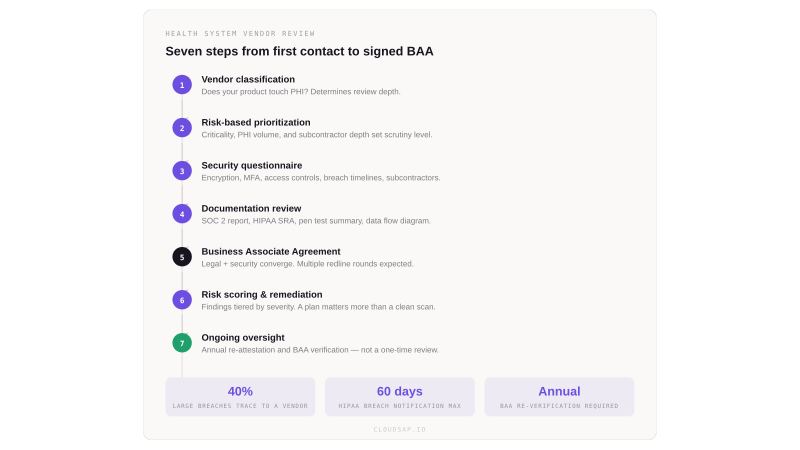
Step 3: The initial security questionnaire
This looks similar to a standard enterprise DDQ, with healthcare-specific additions. Expect questions on:
- Encryption. Is ePHI encrypted at rest and in transit? The 2026 HIPAA Security Rule update is expected to eliminate the "addressable" designation for encryption, making it a hard requirement instead of a judgment call. Have a specific, current answer ready.
- Multi-factor authentication. Same story. MFA is moving from optional to required for any system touching ePHI under the proposed 2026 rule. If you don't enforce it everywhere yet, say exactly where the gaps are and your remediation timeline.
- Access controls and audit logging. Who can access PHI, how is that access reviewed, and what audit trail exists? Health systems expect granular, role-based access, not broad administrative permissions.
- Incident response and breach notification. HIPAA's Breach Notification Rule sets a 60-day outer limit for reporting. Your BAA will likely specify a shorter internal window, sometimes 24 to 72 hours, so the health system has time to meet its own regulatory clock. State your actual notification SLA, not the HIPAA maximum
- Subcontractor disclosure. List every downstream vendor that touches PHI through your systems. This is one of the most scrutinized areas in 2026. Hospitals now document annual verification that every layer of the subcontractor chain is covered.
Step 4: Documentation review
Beyond the questionnaire, expect requests for evidence: your most recent SOC 2 report, HIPAA risk assessment documentation, penetration test summary, and, increasingly, a formal HIPAA Security Risk Assessment specific to your organization, not a generic template.
Health systems are also starting to request asset inventories and data flow diagrams showing how PHI moves through your architecture. Build one before you're asked. Missing documentation is one of the most common reasons vendor onboarding stalls.
Step 5: The Business Associate Agreement (BAA)
Permitted and prohibited uses of PHI, including minimum-necessary standards. Administrative, physical, and technical safeguards aligned to the Security Rule. Breach notification timelines, often shorter than HIPAA's 60-day maximum. The health system's right to audit, including remote or on-site assessments. Subcontractor flow-down requirements, so every downstream party is bound to the same standards.
The 2026 update is expected to require
BAA language addressing MFA, encryption standards, and vulnerability testing procedures directly. Generic compliance language is losing acceptability. Expect redlines, expect multiple rounds, and expect legal, privacy, security, and procurement to all weigh in before signature.
6–10 weeks to a defensible programme.
Step 6: Risk scoring and remediation
After the questionnaire and documentation review, the health system scores your risk posture. Findings get sorted into severity tiers, and you'll typically receive a remediation roadmap with deadlines attached to the higher-severity items.
Health systems frequently onboard vendors with open findings, provided there's a documented remediation plan and a realistic timeline. What kills deals is silence: no plan, no timeline, no owner.
Step 7: Ongoing oversight, not a one-time review
The relationship continues past signature. Health systems must conduct annual vendor risk assessments and, under the 2026 update, document annual verification that each BAA still reflects current requirements. Expect:
Annual re-attestation of your security posture. Notification obligations whenever your architecture changes, including new cloud regions, new subcontractors, or new data flows. Periodic re-review triggered by new PHI elements or expanded scope of your service.
Vendors who treat the BAA as a one-time signature get flagged in the next annual review cycle. Build a recurring internal process to keep your evidence current, not just your original submission.
How do I make this process faster?
Build a healthcare-specific evidence pack in advance: current SOC 2 report, HIPAA risk assessment, subcontractor list, data flow diagram, and BAA template language ready to negotiate from. Health systems move faster with vendors who show up prepared.
Assign a named owner for security and compliance questions. A specific contact, not a general sales inbox. This one change compresses response time significantly.
Get ahead of the 2026 rule changes. Encryption and MFA are moving from best practice to mandatory. Build the roadmap now, before a health system asks.
The bottom line: Health system vendor reviews combine security diligence with regulatory liability. The vendors who move fastest through this process understand it's a legal relationship as much as a technical one, and they show up with documentation to prove both.
Ready to move faster?
Too much to do,
too important to ignore.
Start with a 30-minute discovery call. If we're not the right fit, we'll tell you and point you in the right direction. If we are, we'll leave the call with a clear plan to get you up and running.