What Enterprise CISOs Are Asking AI Vendors in 2026: And How to Answer
What Enterprise CISOs Are Asking AI Vendors in 2026
AI vendor security reviews used to be an afterthought. A few extra rows in the standard DDQ. A question about encryption. Maybe a line about GDPR.
That era ended. In 2026, enterprise CISOs are running dedicated AI risk assessments before signing any vendor contract that touches a model, a training dataset, or an agentic workflow. Splunk's 2026 CISO Report found that 96% of security leaders say AI governance now falls to them. Okta's Global CISO Insights survey found 81% worry about excessive AI access.
If you sell an AI product into the enterprise, these are the questions landing in your inbox; and what a credible answer looks like.
What frameworks should we comply with?
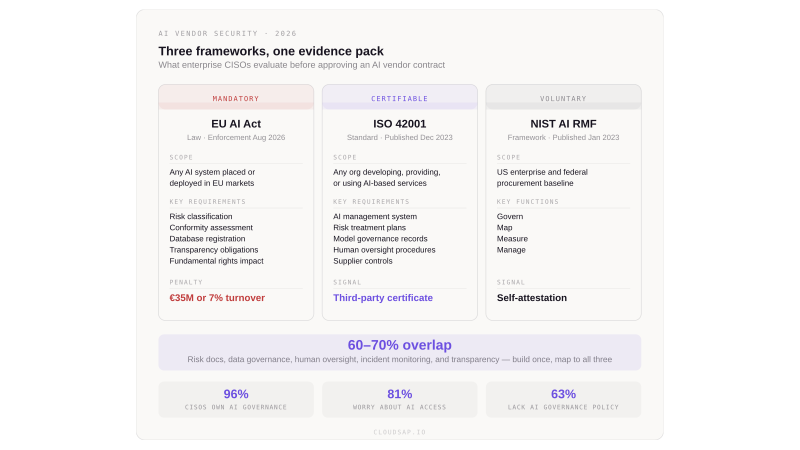
Three frameworks dominate every enterprise AI security review in 2026.
- ISO 42001 is the certifiable international standard for AI management systems. Published in December 2023, it's structured like ISO 27001 (policies, risk treatment, monitoring, documentation, continual improvement) but scoped specifically to AI. AWS, Anthropic, and ServiceNow have all achieved ISO 42001 certification. Enterprise procurement teams increasingly treat it as a vendor qualification requirement.
- NIST AI RMF is the U.S. voluntary risk management framework. It's organized around four functions: Govern, Map, Measure, Manage. Federal agencies reference it in procurement requirements. The FTC, SEC, and DoD cite it in regulatory guidance. For any vendor selling into U.S. enterprise or federal accounts, NIST AI RMF alignment is effectively mandatory.
- The EU AI Act is law. Penalties reach €35 million or 7% of global annual turnover. GPAI model providers must comply with obligations effective August 2025, with enforcement beginning August 2026. If your product touches EU users or operates within an Annex III high-risk category, compliance is non-negotiable.
The good news: roughly 60–70% of the required work overlaps across all three frameworks. Risk documentation, data governance, human oversight, incident monitoring, and transparency documentation can be built once and mapped to each.
Where does our data go?
Does customer data enter your model? Is it used for training?
This is the first question every CISO asks. State explicitly whether customer data is used to train, fine-tune, or improve your models. If it isn't, say so in your DPA and reinforce it in your security documentation. If it is, explain exactly what data is used, how it's anonymized, and how customers can opt out.
Where is data processed and stored?
Name your hosting regions. Describe whether data stays within a customer's chosen jurisdiction. Enterprise buyers in the EU use this question to assess AI Act exposure and GDPR compliance simultaneously.
Can data be extracted or reconstructed from the model?
CISOs are now asking about model memorization: the risk that training data can be leaked through adversarial prompting. Describe what safeguards you've built against extraction attacks and what testing you've performed.
How do you govern your AI systems?
Do you maintain an AI system inventory?
ISO 42001 Clause 8 requires operational planning that includes a documented inventory of AI systems. NIST AI RMF's Map function requires the same. Maintain a living register of every model in production — what it does, what data it processes, who owns it, and when it was last assessed.
Do you have model cards or system documentation?
Model cards describe your AI system's purpose, training methodology, performance benchmarks, known limitations, and intended use cases. Enterprise buyers expect this documentation before procurement approves the contract.
Who owns AI risk decisions?
Name the person. CISOs want to know who in your organization makes deployment decisions, approves risk treatment plans, and escalates incidents involving AI systems. A governance committee is fine. A named accountable executive is better.
We help you with the AI section of the
security questionnaire.
How do you manage AI-specific risks?
How do you test for bias and fairness?
Describe your testing methodology. What metrics do you use? How often do you test? Do you test across demographic subgroups? Enterprise buyers in regulated industries (financial services, healthcare, insurance) face their own fairness obligations. Your bias testing is evidence they need for their own compliance programs.
How do you handle hallucinations and output reliability?
Explain your guardrails. What validation layers exist between model output and customer-facing results? Do you run automated accuracy checks? Do you maintain human-in-the-loop processes for high-stakes outputs? Hallucination risk is no longer a technical curiosity. It's a liability question.
What happens when your model fails?
Describe your incident response process for AI-specific failures. How do you detect model degradation? What's your notification timeline? How do you roll back a problematic model version? CISOs want to see that your AI incident response is as structured as your infrastructure incident response.
What about agentic AI?
Agentic AI systems — autonomous agents that take actions, make API calls, and chain decisions — introduce access control challenges that traditional vendor assessments weren't built to evaluate.
How do you manage agent permissions?
CISOs want to know what your agents can access, what actions they can take, and whether those permissions follow least-privilege principles. Okta's research found organizations are applying human identity policies to non-human agents, relying on shared credentials with broad permissions. If your product deploys agents, describe how agent identity, authentication, and authorization work.
Can customers audit agent activity?
Provide audit logs that show every action an agent took, every system it accessed, and every decision it made. Enterprise buyers need this trail for their own compliance obligations — and increasingly for EU AI Act conformity assessment requirements.
What certifications and evidence should I have ready?
Build a vendor evidence pack that covers the overlap. At minimum:
SOC 2 Type II report (security TSC, plus any additional criteria relevant to your product). ISO 42001 certification or a documented roadmap with a projected certification date. NIST AI RMF self-attestation mapped to the Govern-Map-Measure-Manage functions. Model cards for every AI system in production. A current data processing agreement with AI-specific clauses. Penetration test executive summary (annual, under NDA). AI incident response plan. Training data provenance documentation.
Companies that have this pack assembled respond to AI security reviews in days. Companies that don't spend weeks chasing documentation across engineering, legal, and product teams while the deal waits.
The bottom line:
Enterprise AI security reviews are no longer a subset of the standard vendor questionnaire. They're a dedicated evaluation with their own frameworks, their own questions, and their own deal-blocking potential. The vendors that close enterprise contracts in 2026 are the ones that speak the CISO's language — ISO 42001, NIST AI RMF, EU AI Act — and back it with evidence before procurement asks.
Ready to move faster?
Too much to do,
too important to ignore.
Start with a 30-minute discovery call. If we're not the right fit, we'll tell you and point you in the right direction. If we are, we'll leave the call with a clear plan to get you up and running.