The 20 Security Questionnaire Questions That Stall Enterprise SaaS Deals (And How to Answer Them)
The 20 Security Questionnaire Questions That Stall Enterprise SaaS Deals (And How to Answer Them)
Your deal was moving. Pricing approved, legal on deck, everything was sailing smoothly. Then procurement sent a 200-row spreadsheet. Your sales rep forwarded it to engineering. Engineering forwarded it to whoever built the auth system. Two weeks later, the buyer followed up. You sent back a half-filled spreadsheet. The deal sat.
Here are the 20 questions that appear in virtually every enterprise questionnaire — SIG, CAIQ, custom DDQs — and what a clean answer looks like.
Certifications & Compliance
1. Do you hold SOC 2 Type II, ISO 27001, or equivalent certifications?
Buyers with 5,000+ employees treat certifications as a pass/fail filter. If you have them, state the framework, the auditor, and the most recent report date. Offer the report under NDA. If you're in progress, give the projected completion date — "we plan to certify eventually" doesn't clear procurement.
2. Are you compliant with GDPR, CCPA, or other data privacy regulations?
Name the specific regulations you comply with. Reference your Data Processing Agreement. If you've appointed a DPO, say so. Vague claims like "we take privacy seriously" flag the response for follow-up.
3. Have you completed a third-party penetration test in the last 12 months?
Yes, and offer the executive summary under NDA. Include the testing firm's name and the date of the most recent engagement. Buyers want to see that you test at least annually and remediate critical findings within defined SLAs.
Data Protection
4. How do you encrypt data at rest and in transit?
Be specific: AES-256 for data at rest, TLS 1.2+ for data in transit. Name where encryption is applied — databases, backups, file storage. If you manage encryption keys through a dedicated KMS, say that too.
5. Where is customer data stored? Can we choose the region?
List your hosting regions. If you offer data residency options, explain how they work. Buyers in the EU and regulated industries use this question to assess jurisdictional risk. A clear answer prevents a five-email thread with legal.
6. How do you handle data retention and deletion?
Explain your default retention period and how customers can request deletion. Describe the deletion process: is it immediate, within 30 days, and does it cover backups? Auditors look for documented procedures here.
7. Do you use subprocessors? If so, which ones?
Maintain a current subprocessor list and link to it. Include what each subprocessor handles and where they're located. Procurement teams cross-reference this against their own vendor policies.
Cloudsapio helps SaaS companies prepare
for SOC 2 Type I and II in 8-16 weeks.
Access Control
8. Do you support SSO via SAML 2.0 or OIDC?
This question appears in every enterprise questionnaire above $25K ACV. A "no" or "on the roadmap" answer can kill the deal outright. If you support it, confirm the protocol and whether it's available on all plans or only enterprise tiers.
9. Do you enforce multi-factor authentication?
Describe what MFA options you support (TOTP, hardware keys, push) and whether it's enforced by default or optional. Buyers want to know if they can mandate MFA for all users in their tenant.
10. How do you manage role-based access control?
Explain your RBAC model. How granular are the roles? Can administrators create custom roles? Can buyers restrict access by team, function, or data type? The more control you hand to the customer, the cleaner this answer lands.
Incident Response
12. Do you have a documented incident response plan?
Describe your internal process. Specify the timeline — access revoked within 24 hours, same day, immediately upon termination. Buyers are checking for dormant accounts with live credentials.
13. What is your breach notification timeline?
Give a number. "Within 72 hours where GDPR applies" or "within 24 hours of confirmed breach" works. Undefined timelines are a red flag for every procurement team.
14. Have you experienced a security breach in the past 24 months?
Answer directly. If yes, explain what happened, how you responded, and what you changed. If no, say so plainly. "We've never had an incident" with zero detail reads as evasive for any mature SaaS company.
Infrastructure & Operations
15. How often do you perform vulnerability scans?
Continuous automated scanning on production environments. Quarterly authenticated scans. Annual third-party penetration test. State your remediation SLAs by severity — critical within 7 days, high within 30, medium within 90.
16. How do you manage patching and system updates?
Describe your patch management cadence and your SLAs for critical vulnerabilities. Automated patching? Change management process? Buyers want evidence that you don't let known vulnerabilities sit.
17. Do you have a business continuity and disaster recovery plan?
Confirm your RTO and RPO targets. Describe your backup frequency and geographic redundancy. If you test the plan, state how often. An untested DR plan is the same as no plan.
Vendors and supply chain risk
18. How do you assess the security of your own vendors?
Describe your vendor risk management process. Do you require SOC 2 reports from critical subprocessors? How often do you reassess? Buyers are checking whether your supply chain creates exposure in theirs.
19. Do you carry cyber liability insurance?
State your coverage amount and confirm it's current. This question is increasingly common in enterprise deals above $100K ACV.
20. Do you provide audit logs to customers?
Explain what events are logged, how long logs are retained, and whether customers can export or access them directly. Enterprise buyers need audit trails for their own compliance obligations.
Why these 20 questions keep coming up
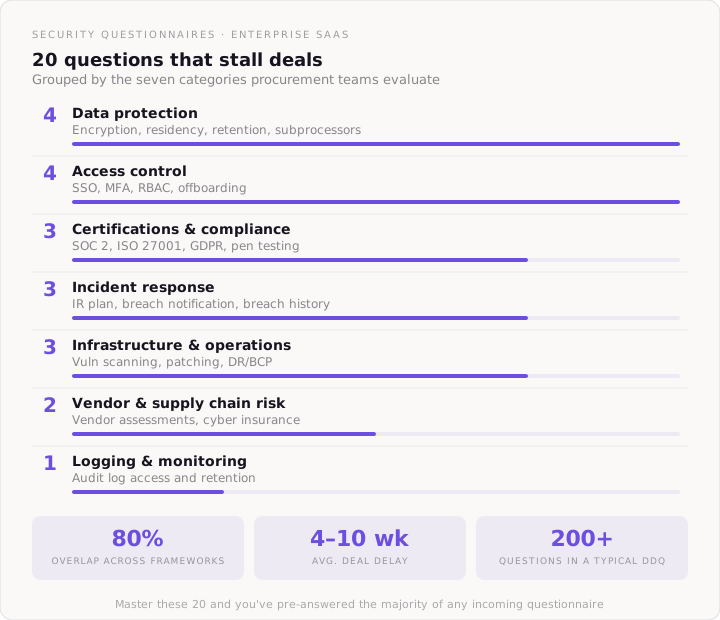
About 80% of security questionnaire content overlaps across frameworks. These 20 questions hit the intersection of SIG, CAIQ, VSA, and custom DDQs. Build approved answers for this list and you've pre-answered the majority of every incoming questionnaire.
The bottom line: Security questionnaires don't have to add 4–10 weeks to your sales cycle. The vendors that close fast are the ones with a master answer library, a current Trust Center, and a compliance platform generating continuous evidence. The questionnaire arrives, you fill it out the same day, and the deal keeps moving.
Cloudsapio can help SaaS companies with:
Ready to move faster?
Too much to do,
too important to ignore.
Start with a 30-minute discovery call. If we're not the right fit, we'll tell you and point you in the right direction. If we are, we'll leave the call with a clear plan to get you up and running.