Your First 30 Days in Vanta: What to Configure, in What Order

Your First 30 Days in Vanta: What to Configure, in What Order
You bought Vanta. The contract is signed, the login works, and now you're staring at a dashboard full of failing tests you don't understand yet.
The order you set things up determines whether Vanta starts working for you in week one, or whether you're still manually uploading screenshots in month three.
This is the playbook. Questions you'll actually ask, answered in the sequence that matters.
Week 1: Lay the Foundation
Do I connect integrations or set up policies first?
Integrations. Every time. Vanta's entire value proposition runs on automated evidence collection. Until you connect your systems, the platform is just a checklist with a nice UI. Policies can wait a few days. Automated monitoring cannot.
Which integrations do I connect first?
Three categories, in this order:
- Your identity provider (Okta, Google Workspace, Azure AD) comes first. This tells Vanta who has access to your systems. It populates your personnel roster, enables SSO tracking, and feeds MFA enforcement checks. Without it, Vanta can't answer the most basic audit question: who are your people?
- Your cloud provider (AWS, GCP, Azure) comes second. This is where most of your automated tests live: encryption settings, network configurations, access controls, logging. Connecting cloud infrastructure unlocks dozens of compliance checks immediately.
- Your HRIS (BambooHR, Gusto, Rippling, Workday) comes third. Your identity provider tells Vanta who currently has access. Your HRIS tells Vanta when someone's employment actually started and ended. Auditors care about both. Connecting your HRIS also pulls in job titles, departments, and start dates: metadata that makes personnel management much easier down the line.
Cloudsapio can get Vanta implemented for you
and ready for SOC 2 in 6 - 10 weeks.
What if I skip the HRIS and just manage personnel manually?
You can. But you'll regret it around month four, when you're manually updating employment records, chasing down offboarding evidence, and explaining to your auditor why your access logs don't match your HR records. The integration takes 15 minutes. Do it now.
What about my task tracker?
Connect Jira, Linear, or Asana in this first week too. Vanta uses your task tracker to route remediation items. When a test fails, and plenty will fail in week one, that's normal: you want those failures flowing into your team's existing workflow, not sitting in a tab nobody checks.
Week 1–2: People and Permissions
How do I organize my personnel?
Vanta uses Groups to segment your team. Think of groups as buckets tied to job function or data access level.
- The question to ask: does this person touch sensitive data? Customer records, production environments, ePHI, HR files. People who do get one task set. People who don't get a lighter version. You can create a specific task set for individuals who don't handle sensitive data and scope down their required policies and security tasks.
Start simple. Two or three groups are enough for most companies under 200 people.
When do I send out employee onboarding tasks?
After you've configured your groups and task sets, but before you've finalized all your policies.
Here's why: employees need to accept policies, complete security awareness training, and install the Vanta agent on their devices. That process takes time. People ignore emails. They forget. They're busy.
Send onboarding invitations at the end of week one or early week two. Enable Vanta's automated reminders. Then give your team a deadline. The onboarding portal lives at app.vanta.com/onboarding. Vanta's built-in security awareness training takes about eight minutes.
Do I need background checks?
Depends on your framework. SOC 2 expects them. You can run discounted checks directly through Vanta via Certn, or integrate your existing provider. Either way, get this in motion early; background checks have their own processing timelines.
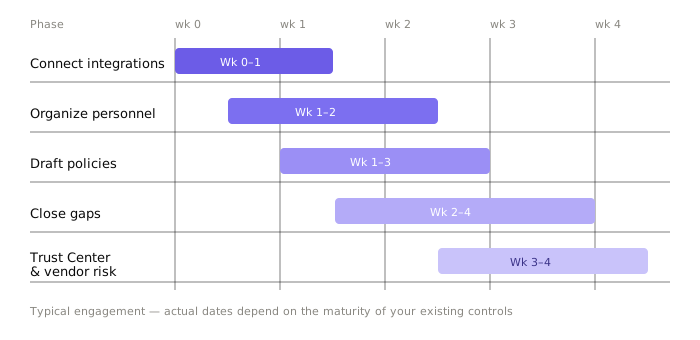
Week 2: Policies and Controls
Should I write policies from scratch?
No. Vanta generates policy templates mapped to your target framework. They're solid starting points. Review them, tailor the language to your actual operations, and publish.
- The common mistake: spending two weeks perfecting policy language before connecting anything else. Policies matter. But a polished Acceptable Use Policy doesn't help if your AWS account isn't connected and Vanta can't verify that your S3 buckets aren't public.
Which policies should I prioritize?
Start with the ones your employees need to accept during onboarding: Information Security, Acceptable Use, and Data Classification hit almost every framework. Then work through the rest: Incident Response, Access Control, Change Management, Business Continuity, Risk Management.
You'll likely have 15–25 policies depending on your framework. Don't try to finalize all of them in one sitting. Aim to have the employee-facing policies published by mid-week two, and the operational policies locked by week three.
What about the Vanta Agent?
The Vanta Agent (also called the Device Monitor) is a lightweight, read-only application your employees install on their company machines. It checks for disk encryption, password manager usage, OS updates, screen lock settings, and antivirus. It's part of the onboarding task set.
Two things to know: it's read-only, so it can't change anything on the device. And employees will still ask if it's spyware. Prepare a one-paragraph internal FAQ before you send the install link.
Week 3–4: Build the Machine
When do I set up my Trust Center?
Now. Your Trust Center is the public-facing page where prospects and customers can self-serve your compliance documentation. Customize the branding, upload your completed certifications (once you have them), and configure NDA workflows for sensitive documents.
The Trust Center isn't just a nice-to-have. It directly reduces inbound security questionnaire volume. Every questionnaire your sales team doesn't have to manually fill out is time back in the pipeline.
What about vendor risk management?
If you're on a plan that includes it, week three is the right time. Import your vendor list, assign security owners, and run your first assessments. Start with your critical vendors- the ones that touch customer data or have production access.
Set up auto-request for evidence so Vanta nudges vendors 30 days before their reviews expire.
How do I know I'm ready for an audit?
Vanta's dashboard gives you a framework completion percentage. That number should be climbing steadily by week three. But the real signal is your test pass rate. When 90%+ of your automated tests are passing consistently (not just once, but over multiple days), you're in the zone.
Before you engage your auditor, make sure you have continuous evidence across at least one full monitoring period. For SOC 2 Type II, that's typically three to twelve months. For SOC 2 Type I or ISO 27001, the timeline is shorter, but you still need clean, consistent results.
The 30-Day Checkpoint
By day 30, here's where you should be:
- All core integrations connected: Identity provider, cloud, HRIS, task tracker, vulnerability scanner. Personnel organized into groups with task sets assigned.
- Employee onboarding complete or near-complete with security training and device agents deployed.
- Policies reviewed, tailored, and published.
- Cloud misconfigurations and access control gaps actively remediated.
- Trust Center configured and branded. Vendor risk management initiated for critical vendors.
If you're hitting these marks, you're ahead of most companies at this stage. The platform is doing its job. Your audit prep just shifted from a fire drill to a monitoring exercise.
Vanta is powerful, but it's not magic. The first 30 days are about connecting systems in the right order, getting your people through onboarding, and letting automated monitoring replace manual evidence collection. Do it in sequence, and the platform compounds. Skip steps, and you'll spend month two doing what you should have done in week one.
Ready to move faster?
Too much to do,
too important to ignore.
Start with a 30-minute discovery call. If we're not the right fit, we'll tell you and point you in the right direction. If we are, we'll leave the call with a clear plan to get you up and running.