Your First 30 Days in Drata: What to Configure, in What Order

Your First 30 Days in Drata: What to Configure, in What Order
Drata sells speed. The dashboard lights up the day you sign the contract. The audit doesn't move that fast. Teams who get the first 30 days in order save themselves months of rework later. Teams who don't spend those months chasing red flags with no clear owner. Here's the order that holds up.
What happens on day one?
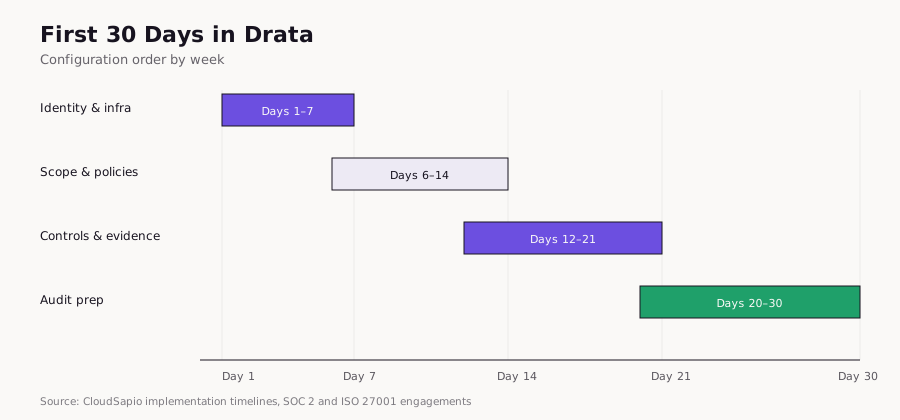
Connect identity and HR. Drata pulls personnel data from your HRIS and matches it to your identity provider — Okta, Google Workspace, Azure AD. This one connection powers a dozen automated tests later: onboarding checklists, offboarding timers, background check tracking. Skip it and every downstream personnel test shows red.
What comes next, in week one?
Cloud infrastructure. Connect AWS, Azure, or GCP, plus version control (GitHub, GitLab) and any MDM tool (Jamf, Kandji) your team runs. Drata starts pulling evidence the moment these go live: encryption settings, access logs, patch status. The earlier they connect, the more historical evidence you'll have banked before your audit window opens.
Why not start with policies? Policies without scope are guesswork. Framework selection has to happen before policy work, not after.
How do you scope the framework?
Pick
SOC 2,
ISO 27001,
HIPAA, or whatever applies, then mark requirements in or out of scope. A 15-person SaaS company doesn't need the same controls as a 300-person healthtech handling PHI. Drata auto-maps controls to your framework, but the scoping calls are yours to make. Get scope wrong and an auditor sends the whole report back.
When do policies get built?
Week two, once scope is locked. Drata ships templates: information security policy, access control policy, incident response plan. Templates cover maybe 60% of a real business. The rest needs rewriting for your actual infrastructure, your actual vendor list, your actual incident process. Generic language gets caught in audit walkthroughs.
Who has to read the policies?
Everyone,
eventually, but not all at once. Assign policies to identity provider groups so the right teams see the right acknowledgments. Engineering doesn't need the vendor management policy. Finance doesn't need the secure development policy. Grouping keeps acknowledgment rates high and cuts down on audit-prep cleanup.
What about controls?
Week three.
Drata auto-maps evidence to controls once integrations are live, but the mapping isn't automatic proof. Review each control, confirm the test actually supports what the control claims, and flag anything that needs manual evidence. Automated coverage typically lands around 70-80% for
SOC 2. The rest needs a person.
What's in that remaining 20-30%?
Vendor risk assessments.
Physical security for hybrid or remote teams. Anything tied to a process that lives outside a connected tool, like a quarterly access review someone runs by hand. These need documented evidence uploaded directly, and they're usually the items teams forget until an auditor asks for them.
When does the risk assessment happen?
Week three or four,
alongside control review. Drata's risk register needs real input: threat likelihood, impact, existing mitigations. A risk assessment copied from a template reads exactly like one to an experienced auditor.
6–10 weeks to SOC 2 Type 1 with Drata.
What happens in the final week?
Audit prep. Invite your auditor to the platform, run the internal readiness report, and clear every control still showing red. This is where the first three weeks pay off. Teams who front-loaded connections and scoping spend week four closing a handful of gaps. Teams who didn't spend it rebuilding the program under deadline pressure.
What's the most common mistake?
Connecting everything on day one without scoping first, or scoping carefully and then never assigning control owners, so nothing moves after week two. Configuration without ownership just produces a well-organized backlog.
Does this need a full-time hire?
Not usually, in the first 30 days. Most early-stage teams assign a fractional or part-time compliance lead, or bring in an implementation partner specifically for this window. The scoping and policy decisions are heavy, one-time work. Once the foundation is set, maintaining it takes far less.
What does Drata's automation not cover?
The judgment calls. Scoping decisions, policy language specific to your business, evidence for processes automation can't see. Drata is a system of record and a testing engine, not a compliance program by itself. Most compliance platforms sell the software and step back from there. Getting from a live account to real audit readiness in 30 days usually takes someone who has run this sequence before.
Bottom line: 30 days is enough time to build a real foundation, if the order holds: identity and infrastructure first, framework scope second, policies third, controls and manual evidence fourth, audit prep last. Skip a step and Drata just automates the confusion faster.
Ready to move faster?
Too much to do,
too important to ignore.
Start with a 30-minute discovery call. If we're not the right fit, we'll tell you and point you in the right direction. If we are, we'll leave the call with a clear plan to get you up and running.