
Which SOC 2 platform should we use? Best SOC 2 platform for SaaS companies
Which SOC 2 Platform Should I Use? Best SOC 2 Platform for SaaS Companies
TL;DR
There is no single best SOC 2 platform. There is a best platform for your stage, your team structure, and who's actually going to run the process day-to-day.
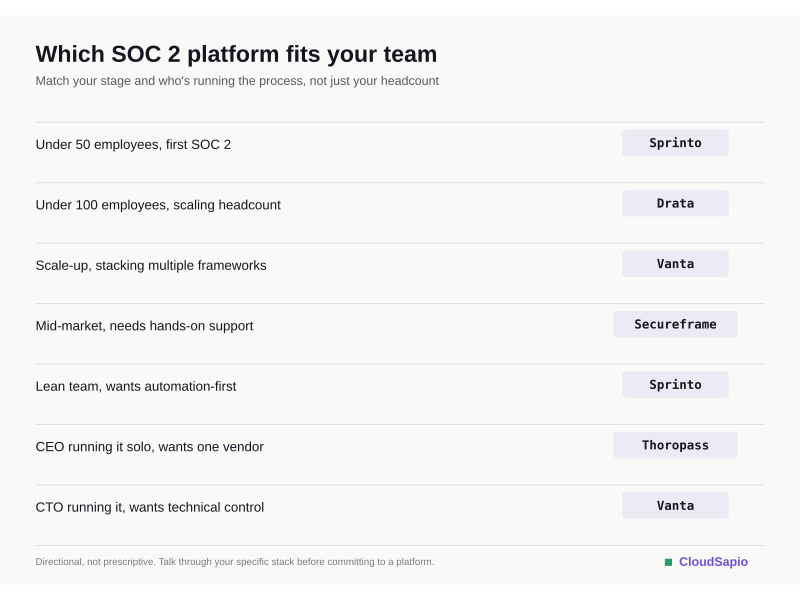
- Sprinto fits SaaS teams under 50 employees on a tight budget.
- Drata fits teams under 100 running their first real audit.
- Vanta fits scale-ups juggling multiple frameworks.
- Secureframe fits mid-market companies that need hands-on support.
And none of it matters if nobody on your team knows how to actually pass the audit, which is the part the platforms don't sell you.
Best for SaaS startups under 50 employees: Sprinto
- Best for: A small, cloud-native team chasing its first SOC 2 Type 1 with no compliance hire yet.
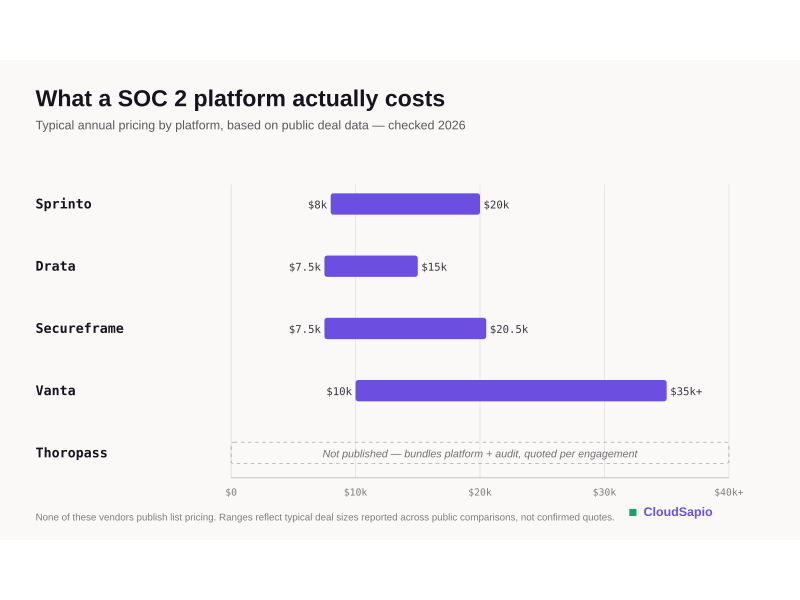
- Pricing: Quote-based, typically $8,000 to $20,000 a year for standard SaaS deployments. Nobody in this category publishes a public rate card, so treat any exact number you see as a starting point, not a quote.
- Average company that uses it: A 15 to 30 person startup running fully on AWS, Azure, or GCP, selling into buyers who just started asking for a SOC 2 report.
- Limitations: Thinner integration library than Vanta or Drata. If your stack has anything non-standard, you'll be filling gaps manually.
Best for SaaS companies under 100 employees: Drata
- Best for: A team past its first SOC 2 conversation and ready for a platform built to handle more than one framework as it grows.
- Pricing: Entry tier typically runs $7,500 to $15,000 a year, in the same range as Secureframe's starting tier.
- Average company that uses it: A 60 to 100 person SaaS company adding ISO 27001 or HIPAA on top of SOC 2 because a bigger customer asked for it
- Limitations: The automation is strongest when you follow Drata's model closely. Teams with custom control structures report less flexibility than they expected.
Best for scale-ups: Vanta
- Best for: A company past its first audit cycle, expanding into new frameworks, and needing packaging that scales with headcount instead of forcing a re-negotiation every year.
- Pricing: Quote-based, typically $10,000 to $35,000+ depending on framework count and company size.
- Average company that uses it: A 100 to 250 person SaaS company with a widening product surface and multiple integrations across cloud, identity, and code repositories.
- Limitations: Reviewers report automation depth thinning out as complexity increases. Some controls end up feeling like surface-level checks rather than continuous validation.
Best for mid-market SaaS: Secureframe
- Best for: A company with more moving parts than a typical startup and no full-time compliance hire to run point.
- Pricing: Fundamentals and Complete tiers, starting around $7,500 and climbing based on headcount and framework scope. Average deal sizes land closer to $20,000.
- Average company that uses it: A 150 to 400 person company, often with international operations, that wants a dedicated compliance specialist walking the team through implementation rather than a self-serve dashboard.
- Limitations:
That extra support comes at a price premium over Sprinto or Drata at comparable company size.
Best for evidence automation: Sprinto
- Best for: A team that wants technical and operational controls automated end to end, not just cloud infrastructure checks.
- Pricing: Same range as above, $8,000 to $20,000 a year.
- Average company that uses it: A lean, cloud-native SaaS team with almost no manual compliance bandwidth internally.
- Limitations: The automation depth that makes it strong here is also what limits it for companies with heavier customization needs or legacy infrastructure.
Best if it's run by the CEO: Thoropass
- Best for: A founder or CEO who is personally handling compliance and wants one vendor to own the whole process, platform and audit included.
- Pricing: Not published. Thoropass bundles software and audit services together, so quotes vary more than single-purpose platforms.
- Average company that uses it: A founder-led company where the CEO doesn't have time to manage a platform vendor and a separate audit firm as two relationships.
Best if it's run by the CTO: Vanta
- Best for: A technical leader who wants granular control over integrations and is comfortable configuring the platform rather than leaning on a CSM.
- Pricing: Same range noted above, scaling with framework count and integrations.
- Average company that uses it: An engineering-led team with a specific or unusual cloud stack, where native connector coverage matters more than guided hand-holding.
- Limitations: The self-serve depth that technical teams like also means less built-in coaching if nobody on the team has been through a SOC 2 audit before.
We help you prepare for
SOC 2 Type 1 in 6–10 weeks.
What you should actually be looking at for your SaaS
Company size gets you in the right range. It doesn't tell you which platform fits. Before you pick one, work through these in order:
- Who's actually going to log in every week. A platform built for a hands-off CTO will frustrate a CEO who needs guidance, and the reverse is just as true.
- What frameworks you'll need in 18 months, not just today. Adding ISO 27001 or HIPAA later costs less on a platform built for multi-framework mapping from day one.
- How unusual your stack is. Native integration coverage varies a lot between platforms. Check the connector list against your actual tools before you buy, not after.
- Who's writing your policies and running your gap assessment. The platform automates evidence. It does not write your access control policy or tell you what to do when a control fails.
- Whether you want your auditor and your software vendor to be the same company or separate ones. Both models exist. Know which one you're buying before you sign.
SOC 2 compliance software vs vCISO: what's the difference?
A SOC 2 platform automates evidence collection. It connects to your cloud provider, identity system, and code repositories, and pulls proof that your controls are working. What it does not do is decide what your controls should be, write your policies, or tell you what "good" looks like for your specific business.
A vCISO is a person, not software. A vCISO firm runs your entire security program: gap analysis, policy writing, remediation planning, vendor risk management, and audit prep, all led by someone who has actually done this before.
Most companies need both, not one or the other. The platform handles the repetitive evidence-gathering work that would otherwise eat 100 to 200 hours of internal time. The human handles the judgment calls the software can't make: which controls actually matter for your risk profile, how to respond when an auditor pushes back, and what to fix before the auditor even asks.
Buying a platform without the expertise behind it is the most common reason first-time SOC 2 audits run long. The dashboard tells you evidence is missing. It doesn't tell you why, or what to do about it.
That's the gap cloudsapio fills. We're not a reseller pushing you toward whichever platform pays the best referral fee.
We're the team that sits inside your existing tooling, whatever you pick, and makes sure the controls you configure are the ones that actually hold up in front of an auditor.
FAQs
Do any of these platforms publish real pricing?
No. Vanta, Drata, Secureframe, Sprinto, and Thoropass all list named packages and route you to a quote. Every number in this article is a typical range from public deal data, not a rate card.
Can I switch platforms after my first audit?
Yes, but it rarely makes sense in the first 12 months. Switching means re-mapping controls and re-connecting integrations. Most companies finish their current audit cycle first, then evaluate switching at renewal.
Do I need a platform at all if I have a vCISO?
Most vCISO engagements still use a platform underneath for evidence automation. The vCISO runs the program; the platform handles the repetitive evidence work.
Is the cheapest platform ever the right call?
Only if your stack is simple and your budget is the primary constraint. For anything beyond a single framework or a standard cloud setup, the time saved by better integration coverage usually outweighs the price difference.
Ready to actually pass your SOC 2 audit?
Picking a platform is step one. Getting through the audit without six months of back-and-forth with your auditor is the part most companies underestimate. If you want a team that's done this before to guide the implementation, whichever platform you land on, talk to CloudSapio.
Ready to move faster?
Too much to do,
too important to ignore.
Start with a 30-minute discovery call. If we're not the right fit, we'll tell you and point you in the right direction. If we are, we'll leave the call with a clear plan to get you up and running.