The Biggest Cybersecurity Scandals of 2026, Explained
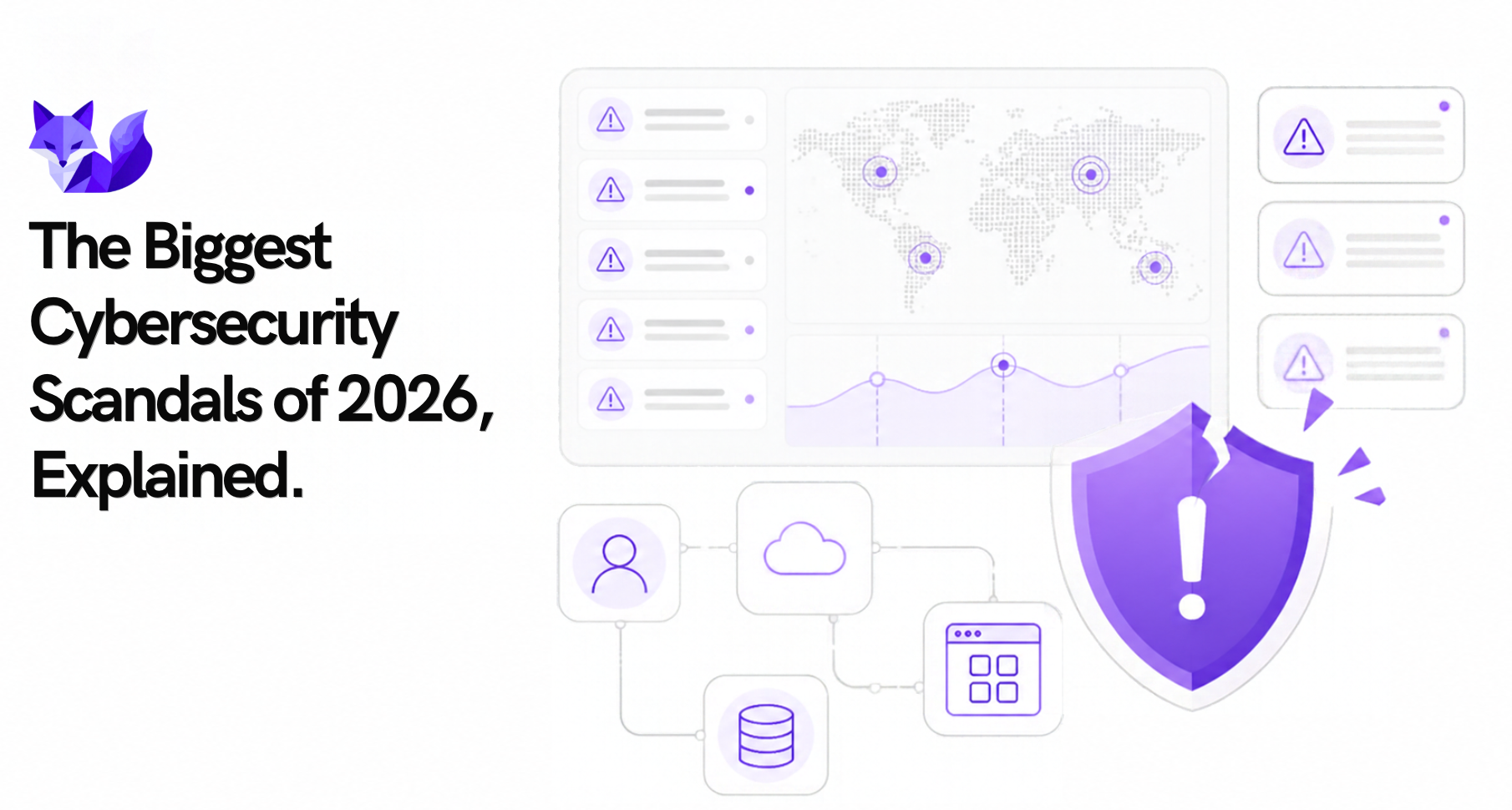
The Biggest Cybersecurity Scandals of 2026, Explained
TL;DR
- Klue: a login issued in 2022 for a short pilot was never switched off. Attackers used it to access data from close to 200 companies.
- French supermarket fridges: attackers switched refrigeration controllers at up to 700 stores to defrost, using internet-exposed devices with default logins and no security updates.
- Software supply chain attacks: backdoored versions of Trivy, Bitwarden, Checkmarx and an npm package stole credentials from the developers using them.
- Instructure (Canvas): the ShinyHunters gang stole data on more than 30 million students and staff, then broke back in after the first ransom wasn't paid.
- Instagram: attackers asked Meta's AI support chatbot to send password reset codes to their own email addresses.
- Firewalls and VPNs: one campaign exposed more than 70,000 credentials by exploiting known bugs and guessing common passwords.
- ID document leaks: IDScan and several smaller services exposed driver's licences and passports, many through basic misconfigurations.
- Could they have been prevented? Mostly yes, or at least made much smaller. Old credentials, unpatched devices and weak identity checks show up again and again.
It's been a big year for people who write breach headlines. An old password from a 2022 pilot project opened the door to almost 200 companies. Someone talked an AI chatbot into handing over Instagram accounts.
Backdoored security tools stole credentials from the people using them to stay secure.
If you run a small software company, it's tempting to read all this and think "that's a big-company problem." Most of these incidents started with something very ordinary. This post walks through six of them, what caused each one, and whether it could have been stopped.
How did we choose which incidents to cover?
There were plenty to pick from. TechCrunch's roundup of the worst hacks of 2026 so far runs to around 20 entries, from health data thefts to attacks on water plants.
We picked seven that meet two tests:
- The cause has been reported. Many companies still haven't said how attackers got in, which makes "could it have been prevented?" impossible to answer honestly.
- The lesson applies to software companies. Nation-state attacks on power grids are important, but your 30-person SaaS team probably isn't defending a dam.
Where a cause is reported but not confirmed by the company, we say so.
What happened in each one, and could it have been prevented?
1. How did a 2022 pilot login hurt almost 200 companies? (Klue)
In June, market research provider Klue had a breach that exposed customers' cloud data. According to TechCrunch, attackers got in using a credential issued in 2022 for a limited pilot. An extortion gang called Icarus then used the data to pressure close to 200 companies, including Jamf, HackerOne and LastPass.
Could it have been prevented? Very likely. The pilot ended, but the credential didn't. Regular access reviews and automatic expiry on temporary credentials would have closed that door years earlier.
2. How did security tools end up stealing credentials? (Supply chain attacks)
Early in the year, backdoored versions of the Trivy scanner, Bitwarden, Checkmarx and a popular npm package stole credentials and tokens from developers who installed them, some through automatic updates. Downstream victims reportedly included OpenAI and Vercel, and an EU cyber agency had data stolen. Australian authorities arrested two suspects by August.
Could it have been prevented? Harder to stop completely, since the software came from trusted sources. The damage could have been much smaller. Pinning software versions, using short-lived tokens in build pipelines and limiting what each token can access all reduce how far a stolen credential can travel.
3. How did a ransom gang hit Canvas twice? (Instructure)
The ShinyHunters gang stole data on more than 30 million students and staff from Instructure, the company behind the Canvas learning platform. When the company didn't pay the first ransom, the gang got back in and defaced Canvas login pages during finals week. Instructure later paid. Instructure hasn't confirmed how attackers got in, but TechCrunch notes this gang usually uses voice phishing, calling staff while posing as IT support.
Could it have been prevented? Probably reduced. Phishing-resistant MFA and strict identity checks for helpdesk requests make phone-based scams much harder. The second break-in is the bigger lesson: after an incident, assume attackers still have a way in until you've proven they don't.
4. Can you talk an AI chatbot into giving you someone's account? (Instagram)
Apparently, yes. Over several months, attackers asked Meta's AI support chatbot to send password reset codes to email addresses they controlled. They took over tens of thousands of Instagram accounts and shared the method in Telegram groups.
Could it have been prevented? Yes. An AI assistant should never be able to change where account recovery codes go without the same identity checks a human agent would need. If your company adds an AI support bot in 2027, test it like a very polite, very gullible new hire.
5. Why are firewalls still getting hacked? (Edge device campaign)
Researchers at Group-IB and NyxLab reported a campaign against Fortinet and Palo Alto firewalls and VPNs that exposed more than 70,000 credentials. The attackers exploited known vulnerabilities and also ran brute-force attacks with common passwords. Many victims later appeared on ransomware leak sites.
Could it have been prevented? In most cases, yes. Patches existed for the vulnerabilities used, and MFA plus decent passwords stop brute-force guessing. Internet-facing devices are first in line for attackers, so they need to be first in line for patches.
6. How do millions of ID documents end up online? (IDScan and others)
Hackers offered a dark-web search tool for driver's licence photos taken from IDScan, an ID verification company. TechCrunch reports the data covers around 150 million drivers in the US and Canada and was taken over about a year. Separately, a hotel check-in system, a money-transfer app, a prison payphone provider and a UK visa service exposed passports or licences belonging to more than 2 million people, mostly through exposed servers and misconfigurations.
Could it have been prevented? IDScan hasn't said how attackers got in. The smaller leaks were basic misconfigurations, which regular cloud configuration scanning would likely have caught. In IDScan's case, the data was reportedly taken over about a year, which suggests the activity went unnoticed for a long time.
7. How do hackers turn supermarket fridges into ovens? (French supermarkets)
On the night of 11 October, attackers got into refrigeration controllers at up to 700 French supermarkets, including Intermarché, Carrefour and Monoprix, and switched them to defrost mode with the food still inside. No alarms went off, and most staff had gone home. Within six hours, many units reached about 50°C, and some equipment melted or caught fire. A second wave hit stores in other European countries on 2 November, and three French blood bank sites were also targeted. France has accused an Iranian state-linked cyber unit, though other officials have pointed to groups from Iran, China and Russia.
How they got in was painfully simple:
- The controllers' web interfaces were reachable from the public internet.
- Many used the username "admin" with a password based on the date, a weakness researchers had disclosed in 2025.
- Several models were years past end-of-life, so they never received a fix.
- Many stores outsource refrigeration to third parties and don't control its security.
Could it have been prevented? Yes. Taking the controllers off the public internet, changing default logins and replacing unsupported devices would have stopped it. One security researcher suggested the attack was easy enough that it could have been "kids messing around." The lesson for software companies: if it's connected to the internet, it belongs on your asset inventory, even if it's a fridge.
What do these incidents have in common?
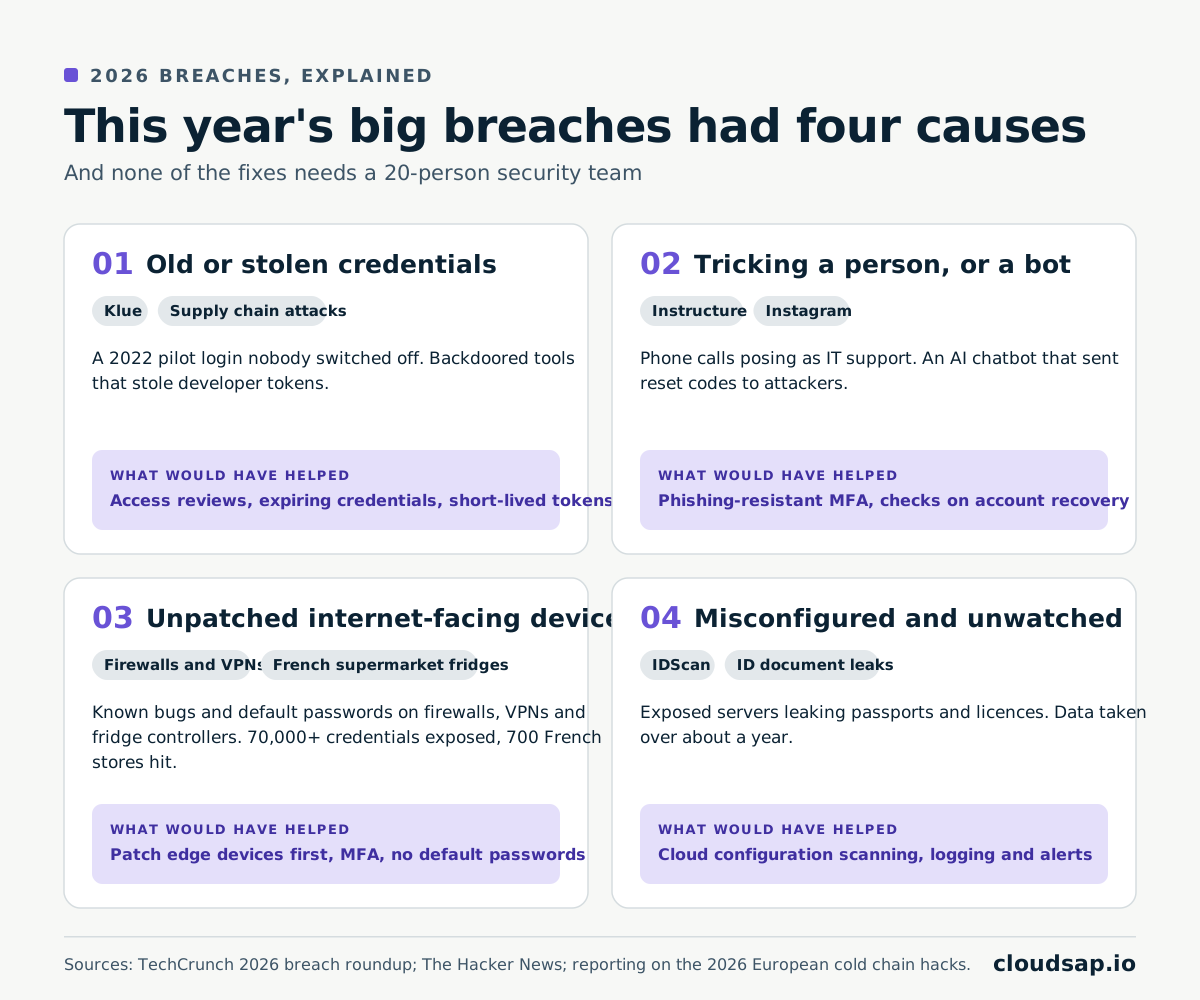
Strip away the headlines and the same four causes keep turning up:
| Root cause | Incidents | The control that would have helped |
|---|---|---|
| Old or stolen credentials | Klue, supply chain attacks | Access reviews, expiring credentials, short-lived tokens |
| Tricking a person, or a bot | Instructure, Instagram | Phishing-resistant MFA, identity checks for account recovery |
| Unpatched internet-facing systems | Firewall and VPN campaign, French supermarket fridges | Fast patching for edge devices, MFA, no default passwords |
| Misconfiguration and slow detection | ID document leaks | Cloud configuration scanning, logging and alerting |
None of these controls are exotic. Most of them are things SOC 2 auditors already ask about: access reviews under CC6, vulnerability management under CC7.1, monitoring under CC7.2. That doesn't mean SOC 2 would have stopped every attack. It does mean the basics in the checklist cover most of what went wrong this year.
What should a small SaaS company take from all this?
Here's a to-do list for this quarter, built from this year's mistakes:
- List every credential that's older than a year. API keys, service accounts, pilot logins and integrations a former employee set up. Turn off anything nobody can explain.
- Lock down your build pipeline. Pin dependency versions, use short-lived tokens, and give each token only the access it needs.
- Move to phishing-resistant MFA for admins and anyone who can reset other people's access.
- Write down how account recovery works. That includes your helpdesk, your support team and any AI bot you've added. Then try to trick it yourself.
- Patch internet-facing devices first, within days for anything on CISA's Known Exploited Vulnerabilities list.
- Scan your cloud configuration continuously, so a public storage bucket gets flagged in minutes, not discovered by a journalist.
- Practise an incident. After you've kicked an attacker out, how would you prove they're gone? Instructure's second break-in shows why that question matters.
None of this needs a 20-person security team. It needs someone to own it and a few hours a week.
FAQs
What was the biggest data breach of 2026?
By reported numbers, IDScan's exposure of around 150 million driver's licence records and Instructure's breach of more than 30 million student and staff records are among the largest. Many companies haven't disclosed final figures yet.
What is a supply chain attack?
An attack on software or a service you trust, so the attacker reaches you through it. In 2026, attackers backdoored well-known developer and security tools, so installing an update was enough to leak credentials.
Could SOC 2 have prevented these breaches?
Not on its own. SOC 2 is an audit of your controls, and a report doesn't stop an attacker. The controls it checks, like access reviews, patching and monitoring, would have reduced most of the failures described here.
What is phishing-resistant MFA?
MFA that can't be passed along by a tricked user, such as hardware security keys or passkeys. Codes sent by text message or read out over the phone can be phished. Security keys can't.
Should we pay a ransom?
The FBI advises against it, and Instructure's experience shows paying doesn't guarantee the attackers stay out. Talk to legal counsel and your insurer before any decision.
How do we know if old credentials are still active?
Check your identity provider, cloud accounts and code repositories for keys and accounts with no recent use, and review third-party integrations. Many compliance platforms can flag these for you.
Want to know if your company has the same gaps?
Book a free 45-minute gap analysis with CloudSapio. We'll check your access reviews, patching, account recovery and monitoring against the mistakes behind this year's biggest incidents, and tell you what to fix first.
Ready to move faster?
Too much to do,
too important to ignore.
Start with a 30-minute discovery call. If we're not the right fit, we'll tell you and point you in the right direction. If we are, we'll leave the call with a clear plan to get you up and running.