Who Offers Hands-On Compliance Support Without a Long-Term Contract?
Who Offers Hands-On Compliance Support Without a Long-Term Contract?
TL;DR
- Flexible, hands-on compliance help exists. Look for fixed-scope projects, monthly retainers you can cancel, or blocks of hours.
- Where to find it: readiness consultancies, vCISO firms and implementation partners usually offer shorter terms than large managed security providers.
- What it costs: a fixed-scope readiness project runs $15,000 to $40,000. A monthly vCISO retainer runs $3,000 to $16,000 depending on days. Hourly advice runs $200 to $400 an hour.
- Watch the small print: notice periods of 30 to 60 days are normal. Auto-renewal and early termination fees are where flexible deals stop being flexible.
- You will still sign some annual contracts.
- Compliance platforms and audit firms usually bill yearly, and SOC 2 itself renews every year.
You find a compliance provider you like. The call goes well. Then the proposal arrives: a 36-month term, auto-renewal, a 90-day notice period and a termination fee described as "standard." It's the gym membership you signed in January, now in enterprise software form.
You wanted help getting audit-ready. You didn't want a long-term commitment. This post covers who offers hands-on compliance support on flexible terms, what each option costs, and what to look for in the contract before you sign.
Why do compliance providers push long contracts?
Three reasons, and only one of them is about you:
- Predictable revenue. A three-year contract looks great on the provider's books. That's the reason that isn't about you.
- SOC 2 repeats every year. Buyers expect a fresh report covering the last 12 months, so the work doesn't stop after the first audit. Providers argue that a longer contract matches that cycle.
- Onboarding takes effort. Learning your systems takes the provider time, and they'd like to earn that back over more than a few months.
The second and third points are fair. They still don't justify locking a 25-person startup into a contract that outlives its runway. A good provider can cover its onboarding costs with a setup fee or a fixed first project, then let you stay because the work is good.
Who offers hands-on compliance support without a long contract?
Here are the main options, starting with us:
- Cloudsapio. A Denver-based team that works hands-on with small software companies on SOC 2 and HIPAA readiness. We work on monthly engagements [CONFIRM: notice period and minimum term], with or without a compliance platform such as Vanta, Drata or Thoropass. Most teams are audit-ready in 8 to 16 weeks, and every engagement starts with a free 45-minute gap analysis.
- Independent readiness consultancies. Many sell a fixed-scope project: they get you audit-ready, then the engagement ends. That's about as flexible as it gets.
- vCISO firms. Most sell monthly retainers based on days per month. BD Emerson notes that 30 to 60 days' notice is typical for fractional security leadership.
- Compliance platform implementation partners. These partners often work in short projects to get the platform set up and your controls passing.
- Freelance compliance consultants. Hourly or by project, with no commitment. Check that they've taken a company through a SOC 2 audit recently.
The providers most likely to want a multi-year deal are large managed security services that bundle monitoring, tools and staff. That can be a good deal at scale, but it's a lot of commitment for a company that just needs to pass its first audit.
Which contract model fits you?
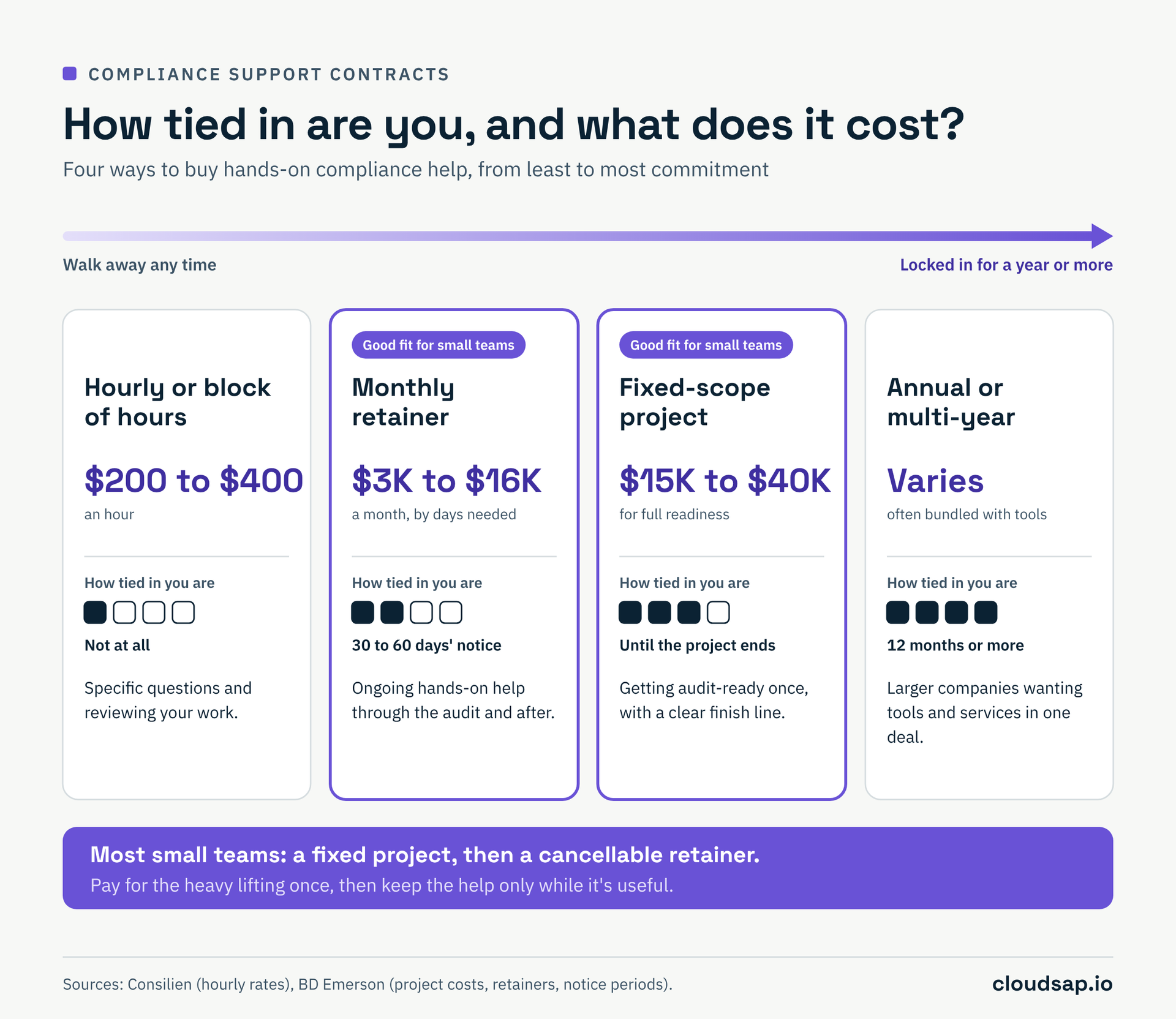
There are four common ways to buy compliance help. They differ in how much you commit and how much you get:
| Model | How you're tied in | Typical cost | Best for |
|---|---|---|---|
| Hourly or block of hours | Not at all | $200 to $400 an hour | Specific questions, reviewing your work |
| Fixed-scope project | Until the project ends | $15,000 to $40,000 for full readiness | Getting audit-ready once |
| Monthly retainer | 30 to 60 days' notice | $3,000 to $16,000 a month | Ongoing hands-on help through the audit and after |
| Annual or multi-year contract | 12 months or more | Varies | Large companies wanting bundled tools and services |
For most small software companies, a fixed project to get ready followed by a cancellable monthly retainer works well. You pay for the heavy lifting once, then keep the help as long as it's useful.
Does flexible cost more?
Sometimes a little, per month. Providers often give a discount for a longer commitment, so a month-to-month rate can be higher than the same work on a 12-month deal.
The maths usually still favours flexibility for small companies, for three reasons:
- You stop paying when the work stops. If you're audit-ready by month four, you don't keep paying through month 36.
- You can switch if it isn't working. A long contract with the wrong provider costs far more than a slightly higher monthly rate with the right one.
- Your needs will change. A 30-person company today might be 80 people next year, with a full-time security hire. A contract signed now won't fit that company.
Also watch for costs outside the retainer. Consilien lists the common extras: GRC software, hours over your plan at $250 to $400 an hour, penetration tests and the audit itself, plus early termination fees. A cheap monthly rate with expensive extras can end up costing more than the higher rate.
What should the contract say?
Read these six clauses before you sign. They decide whether "no long-term contract" is true:
- Term. Is it monthly, or is there a minimum period? "Monthly billing" and "monthly term" are different things.
- Notice period. How many days' notice to cancel? 30 to 60 days is normal. Ninety days on a monthly deal is a warning sign.
- Auto-renewal. Does a fixed term roll over automatically? If so, put a reminder in your calendar a few weeks before the notice deadline.
- Termination fees. Is there a fee for leaving early? If so, how is it calculated?
- Scope. What's included each month, in hours or deliverables? Vague scope means arguments later.
- Handover. If you leave, do you keep your policies, evidence and documentation? You should. You paid for them, and your next auditor will ask for them.
The handover clause matters most. A provider who keeps your policies hostage when you leave has found a way to create a long-term contract without calling it one.
FAQs
Can I get SOC 2 help on a month-to-month basis?
Yes. Many readiness consultancies and vCISO firms offer monthly retainers you can cancel with notice, usually 30 to 60 days.
Is a fixed-scope project better than a retainer?
A project suits a one-time goal, like getting ready for your first audit. A retainer suits ongoing work, like running the program through the observation window and the yearly renewal. Many companies do a project first, then switch to a smaller retainer.
Will I still need annual contracts?
Probably for some things. Compliance platforms and audit firms often bill annually. You can still keep the hands-on help flexible.
What happens to my policies and evidence if I cancel?
That depends on your contract, so check the handover clause. Make sure you keep everything created for you, in a format you can use elsewhere.
Does a short contract mean less commitment from the provider?
It shouldn't. A provider who has to earn your renewal every month has a good reason to keep doing good work.
How do I compare quotes on different terms?
Work out the total cost over 12 months for each, including setup fees, extras and termination fees. Then compare what each one would cost if you left after six months.
Want hands-on help without the long contract?
Book a free 45-minute gap analysis with CloudSapio. We'll show you where you stand, what it will take to get audit-ready, and how we'd work with you, with terms you can actually read.
Ready to move faster?
Too much to do,
too important to ignore.
Start with a 30-minute discovery call. If we're not the right fit, we'll tell you and point you in the right direction. If we are, we'll leave the call with a clear plan to get you up and running.