How Long Does a SOC 2 Audit Take?

How Long Does a SOC 2 Audit Take?
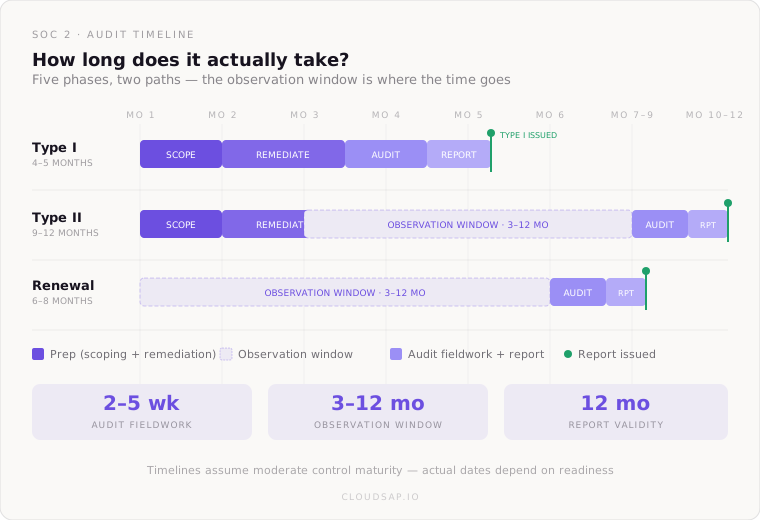
The boring answer: it depends on which clock you're looking at. The audit itself (when an auditor reviews your controls) takes two to five weeks. The entire journey from "we need SOC 2" to "here's the report" takes four to twelve months.
Most of that time isn't spent in the audit. It's spent getting ready for one. Here's how the timeline actually breaks down, phase by phase.
What's the difference between Type I and Type II?
- SOC 2 Type I evaluates whether your controls are properly designed at a single point in time. Think of it as a snapshot. The auditor checks that the right policies, processes, and systems exist on a specific date. There's no observation window. Total timeline from kickoff to report: roughly two to four months.
- SOC 2 Type II evaluates whether your controls actually work over a sustained period. The auditor checks design and operating effectiveness across a three to twelve-month observation window. Total timeline: six to twelve months, sometimes longer.
Type I is faster. Type II is what enterprise buyers ask for. Most companies start with Type I to unlock near-term deals, then transition to Type II for long-term credibility.
What are the phases?
Five distinct phases. Each one has its own timeline and its own stall points.
- Phase 1: Scoping and readiness (2–6 weeks). You define which systems, trust services criteria, and environments are in scope. Security is mandatory. Availability, confidentiality, processing integrity, and privacy are optional — you add them based on what your customers require. During this phase, you run a gap assessment against the framework and identify what's missing. Teams with mature controls finish in two weeks. Teams building from scratch need six or more.
- Phase 2: Remediation (2–8 weeks). You close the gaps. Write missing policies. Implement access controls. Configure logging. Set up your compliance platform. Deploy employee security training. The range here is wide because it depends entirely on how much infrastructure you already have. A company with SSO, MFA, and encryption already deployed might need two weeks of documentation work. A company without centralized identity management might need two months of engineering.
- Phase 3: Observation window (Type II only, 3–12 months). This is the phase that makes Type II take so long. Your controls need to operate consistently across the entire window. The auditor will sample evidence from throughout the period — access reviews, incident logs, change management records, vulnerability scan results. A three-month window is the minimum most auditors accept. Six months is common. Twelve months is the gold standard for enterprise buyers.
- Phase 4: Audit fieldwork (2–5 weeks). The auditor reviews evidence, tests controls, interviews your team, and documents findings. Type I fieldwork is typically two to three weeks. Type II fieldwork runs two to five weeks depending on scope complexity. This phase moves fast when evidence is organized and accessible. It stalls when the auditor is chasing screenshots and waiting for email replies.
- Phase 5: Report drafting and delivery (2–4 weeks). The auditor writes the report, you review the system description for accuracy, and the final report is issued. This phase is mostly in the auditor's hands.
What slows the process down?
- Late auditor engagement.
CPA firms that specialize in
SOC 2 book up months in advance. If you start looking for an auditor in Q3 and want a report by year-end, you're already behind. Engage your auditor during the readiness phase — before you need them.
- Manual evidence collection. Teams that collect evidence through screenshots, spreadsheets, and shared drives spend dramatically more time in every phase. A compliance automation platform pulls evidence continuously from your connected systems. The difference between manual and automated evidence collection can compress the entire timeline by weeks.
- Scope creep.
Adding trust services criteria mid-process forces you to map additional controls, collect additional evidence, and potentially extend the observation window. Lock scope early.
- Gaps in periodic controls. Access reviews, risk assessments, and vendor evaluations need to happen on a defined cadence throughout the observation window. Missing a single cycle creates a gap the auditor will flag. Build these into your compliance calendar from day one.
Can I speed this up?
Yes. 3 levels.
- Use a compliance platform. Tools like Vanta, Drata, or Thoropass connect to your infrastructure and collect evidence automatically. They map controls to framework requirements, track test pass rates, and surface gaps in real time. Companies using automation consistently report shorter prep timelines — often by several weeks.
- Start with Type I. A Type I report can be completed in two to four months. It satisfies many buyer requirements in the near term and lets your team build operational maturity while the Type II observation window runs in the background.
- Run readiness and remediation in parallel. You don't need to finish the gap assessment before you start fixing things. If you already know your access review process is weak or your incident response plan doesn't exist, start working on those while the readiness assessment continues.
Cloudsapio can help you
prepare
for SOC I and II in 8-16 weeks.
How long until I need to do this again?
SOC 2 reports are generally treated as valid for twelve months. Your customers and their auditors will expect a current report.
For Type II, the renewal cycle is more predictable than the initial audit. You already have controls in place, evidence flowing, and an auditor relationship established. Renewal audits typically take six to eight months from observation window start to report delivery.
The organizations that stay perpetually audit-ready — continuous monitoring, automated evidence, quarterly access reviews — compress renewal to a routine exercise. The ones that treat SOC 2 as an annual fire drill repeat the same pain every cycle.
What does the timeline look like end to end?
For a first-time Type I with moderate control maturity: four to five months total. Two to four weeks of scoping, three to six weeks of remediation, two to three weeks of fieldwork, two to three weeks for the report.
For a first-time Type II with a six-month observation window: nine to twelve months total. The same scoping and remediation upfront, plus the observation period, plus fieldwork and reporting on the back end.
For a Type II renewal: six to eight months, mostly consumed by the observation window. Fieldwork and reporting are faster because the auditor already knows your environment.
The bottom line: The audit itself is the short part. Preparation and the observation window are where the time goes. Companies that invest in automation, lock scope early, and engage their auditor before they need one consistently hit the shorter end of every range. The report is a deliverable. The system that produces it is the real asset.
Ready to move faster?
Too much to do,
too important to ignore.
Start with a 30-minute discovery call. If we're not the right fit, we'll tell you and point you in the right direction. If we are, we'll leave the call with a clear plan to get you up and running.