How Can I Choose a Reliable SOC 2 Readiness Provider?
TL;DR
- A reliable provider is one that gets you through the audit with no surprises, on the timeline and budget it quoted.
- Check three things before you book a call: experience with companies your size, real client references, and a clear answer on auditor independence.
- On the call, ask who does the work, how much engineering time you'll need, and what happens after the audit. The answers tell you more than the sales deck.
- Red flags: guaranteed passes, a Type II "in a few weeks," no named contact, and vague scope.
- Compare proposals on total cost over 12 months, including the extras, and on what you keep if you leave.
Every SOC 2 readiness provider has the same website. There's a shield icon, a photo of people pointing at a laptop, and a promise that you'll be "audit-ready in weeks." Somewhere near the bottom, there's a logo wall of companies you've definitely heard of.
None of that tells you whether they'll still answer your emails in week six, when your engineers are stuck on access reviews and the auditor wants evidence by Friday. This post shows you how to tell the reliable providers from the ones with a good website.
What does "reliable" actually mean for a readiness provider?
It means four things, and you can check all of them before you sign:
- You pass the audit without surprises. The auditor doesn't find gaps your provider should have caught.
- They hit the timeline they quoted. If they said 12 weeks, it isn't 30.
- The price holds. No "out of scope" invoices halfway through.
- They're there when you need them. Answers within a day or two, from someone who knows your setup.
A reliable provider can be small or big, cheap or expensive. What matters is that it does what it said it would do. That's what you're testing in the rest of this post.
What should you check before the first call?
Ten minutes of homework saves you three demo calls. Look for these:
- Clients your size. Look at case studies and the logo wall. If every logo is a Fortune 500 company, they may not be set up for a 25-person team.
- Reviews on G2 or Clutch. Read the three-star reviews first. They tend to be the most honest about what went wrong.
- Who'll actually do the work. Check LinkedIn for the team. You want people who've been through SOC 2 audits, ideally former auditors or security leads.
- Their stance on auditor independence. BD Emerson puts it plainly: the CPA firm that signs your SOC 2 opinion can't also design and build the controls it audits. If a provider sells readiness and the audit together, look for how they keep the two apart.
- Which compliance platforms they work with. If you already pay for Vanta, Drata or similar, they should work inside it.
If you can't find any of this on their website, that's useful information too.
What should you ask on the first call?
These eight questions cover most of what matters. Listen for specifics. A reliable provider answers with names, numbers and examples.
| Question | A good answer sounds like | Worry if you hear |
|---|---|---|
| Who will I work with each week? | A named person, with their background | "Our team" |
| How many companies our size have you taken through SOC 2? | A number and a reference you can call | "Lots" |
| How much engineering time will we need? | A rough estimate in hours a week | "It depends," with no number after it |
| How long until we're audit-ready? | A range, and what would make it longer | "A few weeks," for any company |
| What's included, and what costs extra? | A written scope with deliverables | "We'll figure it out as we go" |
| How do you work with our auditor? | Clear separation, plus help choosing one | "We're the auditor too," with no explanation |
| What happens after the audit? | A plan for the yearly renewal | Silence |
| What do we keep if we leave? | All policies, evidence and documents | Anything less |
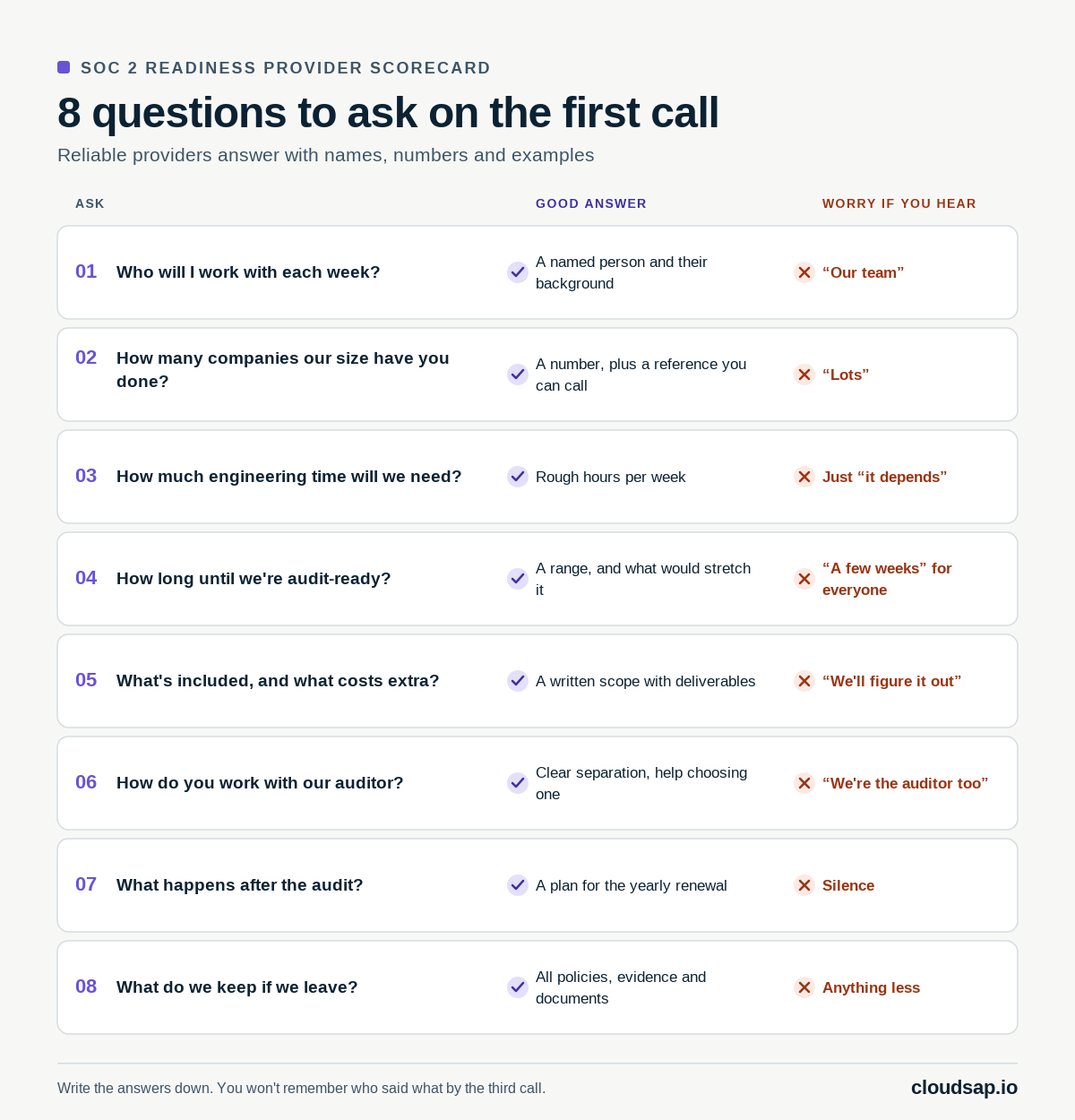
Write the answers down. Two weeks later, when you're comparing three providers, you won't remember who said what.
What are the red flags?
Walk away, or at least slow down, if a provider:
- Guarantees you'll pass. Only the auditor decides that. A provider can promise you'll be well prepared, and that's all.
- Promises a Type II report in a few weeks. A Type II needs an observation window of at least a few months. A fast timeline only makes sense for readiness or a Type I.
- Sends 40 policy templates and calls it readiness. Auditors test whether you follow your policies. Templates nobody has adapted to how you work create findings.
- Can't name who'll do the work. Your project may end up with whoever is free that week.
- Won't give a price range after the first call. They know enough about your size and setup to give a ballpark.
- Locks you into a long contract before any work starts. A reliable provider is happy to earn your renewal.
- Talks only about the tool. Software helps, but readiness is mostly people deciding things and changing how they work.
How do you compare proposals?
Line up the proposals and work through these steps:
- Add up the 12-month cost. Include the setup fee, the monthly or project fee, extra hours, and anything listed as "not included," such as the compliance platform, the penetration test and the audit itself.
- Compare what's actually delivered. Count the specific outputs: policies written, gap assessment report, evidence set up, mock walkthrough. Ignore phrases like "strategic guidance."
- Check the time they need from your team. A cheaper proposal that needs 15 hours a week from your CTO can end up costing more.
- Read the exit terms. Notice period, termination fees, and whether you keep your documents.
- Call one reference for each finalist. Ask what went wrong and how the provider handled it. Every project has a bad week. You want to know what happened during theirs.
For reference, BD Emerson puts full readiness support at $15,000 to $40,000 for a one-off project, and a gap assessment alone at $5,000 to $15,000. If a quote is far outside those ranges, ask why.
FAQs
How many providers should we talk to?
Three is usually enough. Fewer and you have nothing to compare. More and the calls start to blur together.
Is a bigger provider more reliable?
Not always. A big firm may put a junior consultant on a small account. A smaller firm may give you a senior person directly. Ask who you'll work with.
Should our readiness provider and auditor be the same firm?
The firm that signs your SOC 2 opinion can't also build the controls it audits. Some firms offer both through separate teams. Many companies choose different firms to keep things simple.
What should a readiness proposal include?
Scope, deliverables, timeline, the named team, what you need to provide, total cost and exit terms.
How do we check references properly?
Ask the reference about their company size, how long readiness took, what went wrong and whether they'd hire the provider again for the renewal.
Can a compliance platform replace a readiness provider?
It can if someone on your team has compliance experience and the time to run the project. Otherwise, the platform tells you what's missing and somebody still has to fix it.
Want to test us against this checklist?
Book a free 45-minute gap analysis with CloudSapio. Bring these questions. We'll answer every one, tell you where you stand today, and give you a realistic timeline to audit-ready.
Book my free gap analysis
Ready to move faster?
Too much to do,
too important to ignore.
Start with a 30-minute discovery call. If we're not the right fit, we'll tell you and point you in the right direction. If we are, we'll leave the call with a clear plan to get you up and running.