Where Can I Find Hands-On Help Preparing for a SOC 2 Audit?
Where Can I Find Hands-On Help Preparing for a SOC 2 Audit?
TL;DR
- Hands-on help means someone works with you. That includes scoping, closing gaps, writing policies, gathering evidence, and getting you ready for the auditor.
- Where to look: your compliance platform's partner list, readiness consultancies, vCISO firms, referrals from your auditor, and other founders who've been through it.
- What it costs: full readiness support runs $15,000 to $40,000 for a one-off project. A gap assessment alone is $5,000 to $15,000, but then you do the fixing.
- How long: with hands-on help, many small SaaS teams are audit-ready in about 8 to 16 weeks, depending on how many gaps they start with.
- The test: ask who will do the work and how many hours of your engineers' time they need. A hands-on provider can answer both.
You bought the compliance platform. You logged in, saw 147 failing tests and a progress bar sitting at 12%. You closed the tab and decided to deal with it after the next release. That was four releases ago.
This is the most common way SOC 2 projects stall. The software tells you what's wrong, but nobody is there to help fix it. This post covers where to find people who will roll up their sleeves and do the work with you.
Why does this matter right now?
Because last week was a rough one. One weekly security review called October 19 to 25 "unusually intense for enterprise security teams". In seven days:
- Capcom disclosed that 11.7 million accounts were exposed.
- Quest Diagnostics detected unauthorized access to one of its lab services systems.
- Ahold Delhaize confirmed malicious activity that disrupted grocery operations in the US and Europe.
- Microsoft attributed a campaign that tried to log into more than 2,250 Microsoft 365 tenants through a ConnectWise backup product.
- Researchers reported a campaign against Fortinet and Palo Alto firewalls and VPNs that exposed more than 70,000 credentials.
- A popular open-source AI library, LiteLLM, had a release compromised in a supply-chain attack.
Your customers' security teams read the same headlines. After a week like this, expect more questionnaires, tougher vendor reviews and less patience for "we're working on it." If SOC 2 has been sitting on next quarter's list, this is a good week to move it up.
What does "hands-on help" actually mean?
It means the provider does the work alongside your team, rather than handing you a report and wishing you luck. Here's what you should expect them to do:
- Scope the audit with you. Decide which systems, people and Trust Services Criteria are in, and which can safely stay out.
- Run the gap assessment. Check your current setup against SOC 2, then explain what each gap means in plain English.
- Write your policies. Draft them to match how your company actually works, then walk your team through them.
- Work through fixes with your engineers. Tell them exactly what to change in your cloud setup, identity provider and code repository, and check the work afterwards.
- Set up evidence collection. Connect your tools to the compliance platform and make sure the auditor will find what they need.
- Get you ready for the auditor. Help choose an audit firm, run a mock walkthrough and prepare your team for interviews.
If a provider only does step 2, that's a gap assessment. It's useful, but you'll still be doing steps 3 to 6 on your own.
Where can you find hands-on SOC 2 help?
These are the five best places to look, roughly in order of how useful they tend to be:
- cloudsapio: We scope the audit, work through fixes with your engineers, write your policies, set up evidence and prepare you for the auditor. We work with or without a compliance platform such as Vanta, Drata or Thoropass, and most teams are audit-ready in 8 to 16 weeks. Start with a free 30-min gap analysis.
- Your compliance platform's partner list. Most compliance platforms keep a list of implementation partners who already know the tool. If you're paying for one, start here, because these partners can work inside the platform you already have.
- Readiness consultancies and vCISO firms. These firms do SOC 2 prep as their main job. Look for ones that work with companies your size, and check reviews on sites like G2 and Clutch.
- Your auditor's referral list. Audit firms can't build your controls, but many will point you to readiness partners they've seen do good work. Those partners already know what that auditor will ask for.
- Other founders. Ask in founder Slack groups, your investor's portfolio network or your accelerator. Someone has done this in the last year and will tell you who was useful and who sent 40 templates and an invoice.
- Your managed IT or security provider. If you already outsource IT, ask whether they offer SOC 2 readiness. Check that they've taken a client through an audit before, rather than learning on your project.
One place to be careful: freelancers you find with a quick search. Some are excellent, but check they've completed SOC 2 audits recently and can name the audit firm.
Who offers hands-on SOC 2 readiness help?
Here are the main providers to look at, starting with us:
- Cloudsapio. A Denver-based team that does SOC 2 readiness work alongside small software companies. We scope the audit, work through fixes with your engineers, write your policies, set up evidence and prepare you for the auditor. We work with or without a compliance platform such as Vanta, Drata or Thoropass, and most teams are audit-ready in 8 to 16 weeks. We also help healthcare companies get ready for HIPAA. Every engagement starts with a free 45-minute gap analysis.
- Implementation partners on your compliance platform's list. These partners know the tool well and can start quickly if you already have a subscription.
- Independent readiness consultancies and vCISO firms. They're a good fit if you also want ongoing security leadership after the audit.
- Readiness teams inside audit firms. Some audit firms run a separate readiness team. That can work, as long as a different team signs your audit opinion.
Whoever you talk to, use the questions further down this post to check how hands-on they really are. We're happy to answer them too.
What does hands-on help look like week by week?
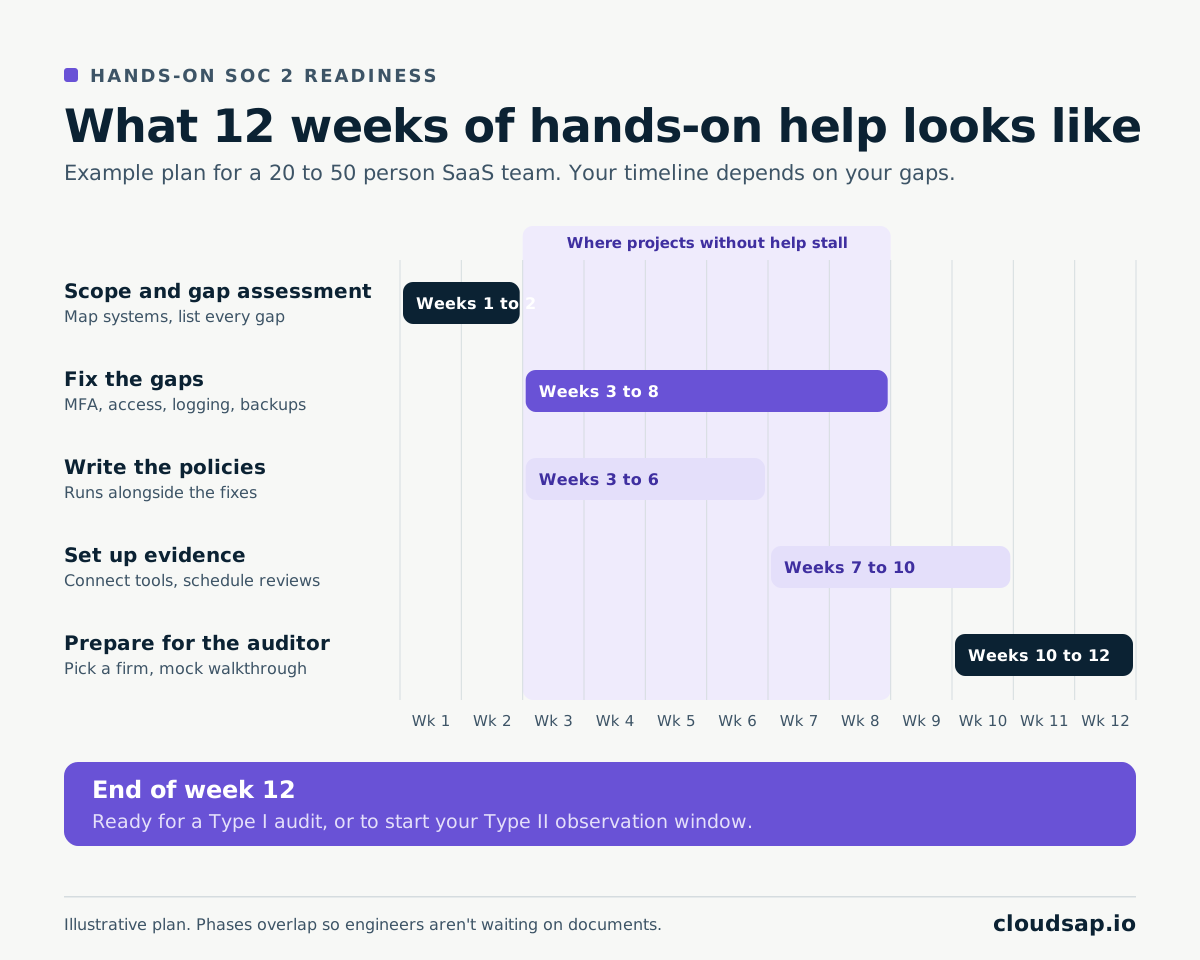
Here's an example 12-week plan for a 20 to 50 person SaaS team. Your timeline depends on how many gaps you start with, but the order stays roughly the same:
- Weeks 1 to 2: Scope and gap assessment. The provider meets your team, maps your systems and lists every gap with an owner.
- Weeks 3 to 8: Fix the gaps. Engineers turn on MFA everywhere, tighten access, set up logging and backups, and put change management in place. The provider checks each fix.
- Weeks 3 to 6: Write the policies. This runs alongside the fixes, so engineers don't sit around waiting for documents.
- Weeks 7 to 10: Set up evidence. Tools get connected, access reviews get scheduled and the evidence starts to build up.
- Weeks 10 to 12: Prepare for the auditor. Pick the audit firm, run a mock walkthrough and coach the people the auditor will interview.
At the end, you're ready for a Type I audit or to start your Type II observation window. The hands-on part matters most in weeks 3 to 8. That's where projects without help tend to stall, somewhere between "enable MFA" and "we'll do it next sprint."
How much does hands-on SOC 2 help cost?
Using BD Emerson's 2026 cost guide:
| Type of help | Typical cost | What you get |
|---|---|---|
| Gap assessment only | $5,000 to $15,000 | A report on what's broken. No help fixing it. |
| Full readiness support | $15,000 to $40,000 | Consultants work through fixes with you, write policies and prepare your team for the auditor. |
| Compliance platform (under 100 people) | $8,000 to $20,000 a year | Software for tracking controls and collecting evidence. |
These costs come on top of the audit itself. Remember to count your team's time too. The cheapest option on paper can turn into the most expensive one if your CTO spends three months on it instead of building product.
As a rough rule, if a big deal is waiting on the report, full readiness support usually pays for itself the day that deal signs.
How do you know if a provider is actually hands-on?
Every provider says they are. Ask these questions on the first call and listen to how they answer:
- "Who will I work with each week?" You want a name and a short bio. "Our team" is not a name.
- "Will you join calls with my engineers?" A hands-on provider says yes and explains what those calls look like.
- "How many hours do you expect from my team?" They should give you a rough number. If they've never been asked, that tells you something.
- "What do you do in the compliance platform yourselves?" Look for answers like "we connect the integrations and fix failing tests with you." Be wary of "we give you access to our templates."
- "Can I talk to a client your size?" A provider who does this work every week will have one ready.
Also check what the proposal promises to deliver. A hands-on proposal lists the work: policies written, fixes reviewed, walkthrough held. A thin one lists "guidance" and "advisory hours" and leaves the rest to you.
FAQs
Can my auditor give me hands-on help?
The firm that signs your SOC 2 opinion can't design and build the controls it audits. Some firms have a separate readiness team. If yours offers that, ask how they keep the two sides apart.
Is a compliance platform enough on its own?
It can be, if someone on your team has compliance experience and the time to own the project. If not, the platform shows you the problems and someone still has to fix them.
How long does hands-on readiness take?
Many small SaaS teams are ready in about 8 to 16 weeks with hands-on help. Teams that start with very few controls in place take longer.
How much engineering time should we plan for?
It depends on your gaps. Most of the work is in access control, logging, MFA, backups and change management. A good provider will estimate it after the gap assessment.
Can we get hands-on help remotely?
Yes. Most SOC 2 readiness work happens over video calls and inside your tools. Being in the same city helps with workshops but isn't needed.
What should we have ready before the first call?
A rough list of your main systems (cloud provider, code repository, identity provider, HR tool), how many people you have, and the date a customer needs the report.
Want someone to do this with you?
CloudSapio works with small software companies on SOC 2 readiness. Book a free 45-minute gap analysis and we'll show you where you stand, what needs fixing first, and how long it will take to be audit-ready.
Ready to move faster?
Too much to do,
too important to ignore.
Start with a 30-minute discovery call. If we're not the right fit, we'll tell you and point you in the right direction. If we are, we'll leave the call with a clear plan to get you up and running.