What's the best SOC 2 audit readiness service for small software companies?
What's the best SOC 2 audit readiness service for small software companies?
TL;DR
- A readiness service gets you ready for the audit. It finds your gaps, helps fix them and preps your team before the auditor shows up.
- There are four main options: do it yourself with a compliance platform, hire a consultant for a gap assessment, hire a full readiness service that does the work with you, or use a managed service that runs it for you.
- Prices vary a lot. A gap assessment runs $5,000 to $15,000. Full readiness support runs $15,000 to $40,000. A compliance platform for a team under 100 people costs $8,000 to $20,000 a year.
- For most small software companies, the best fit is a compliance platform plus hands-on readiness help, so engineers fix things and someone else handles the policies, evidence and auditor prep.
- Your auditor can't also build your controls.
- If one firm offers to do both, ask how they handle independence.
You searched "best SOC 2 readiness service" and got 40 results. Every one of them says it's the best, and the top three are ads. Each promises you'll be "audit-ready in weeks," and one of them has a cartoon rocket.
The honest answer is that the best service depends on how big your team is, how much engineering time you can spare, and how soon a customer needs the report. This post walks through the options so you can choose without booking twelve demo calls.
What does a SOC 2 readiness service actually do?
It does the work between "we should get SOC 2" and "the auditor is here." A good one covers these steps, in this order:
- Scoping. Decides which systems, teams and Trust Services Criteria are in the audit. Most small SaaS companies start with Security, and often add Availability.
- Gap assessment. Compares what you do today with what SOC 2 expects. This is when you find out "we use MFA" means "most of us use MFA, most of the time."
- Remediation plan. Lists every gap with an owner and a due date.
- Policies. Writes the 15 or so policies auditors expect, adapted to how your company works.
- Evidence setup. Connects tools and sets up the screenshots, logs and records the auditor will ask for.
- Auditor prep. Helps choose an auditor, runs mock walkthroughs and coaches your team for interviews.
The gap assessment alone usually takes 6 to 8 weeks, plus however long the fixes take. A readiness service exists so you're not working through steps 2 to 6 on your own between sprints.
What types of readiness services are there?
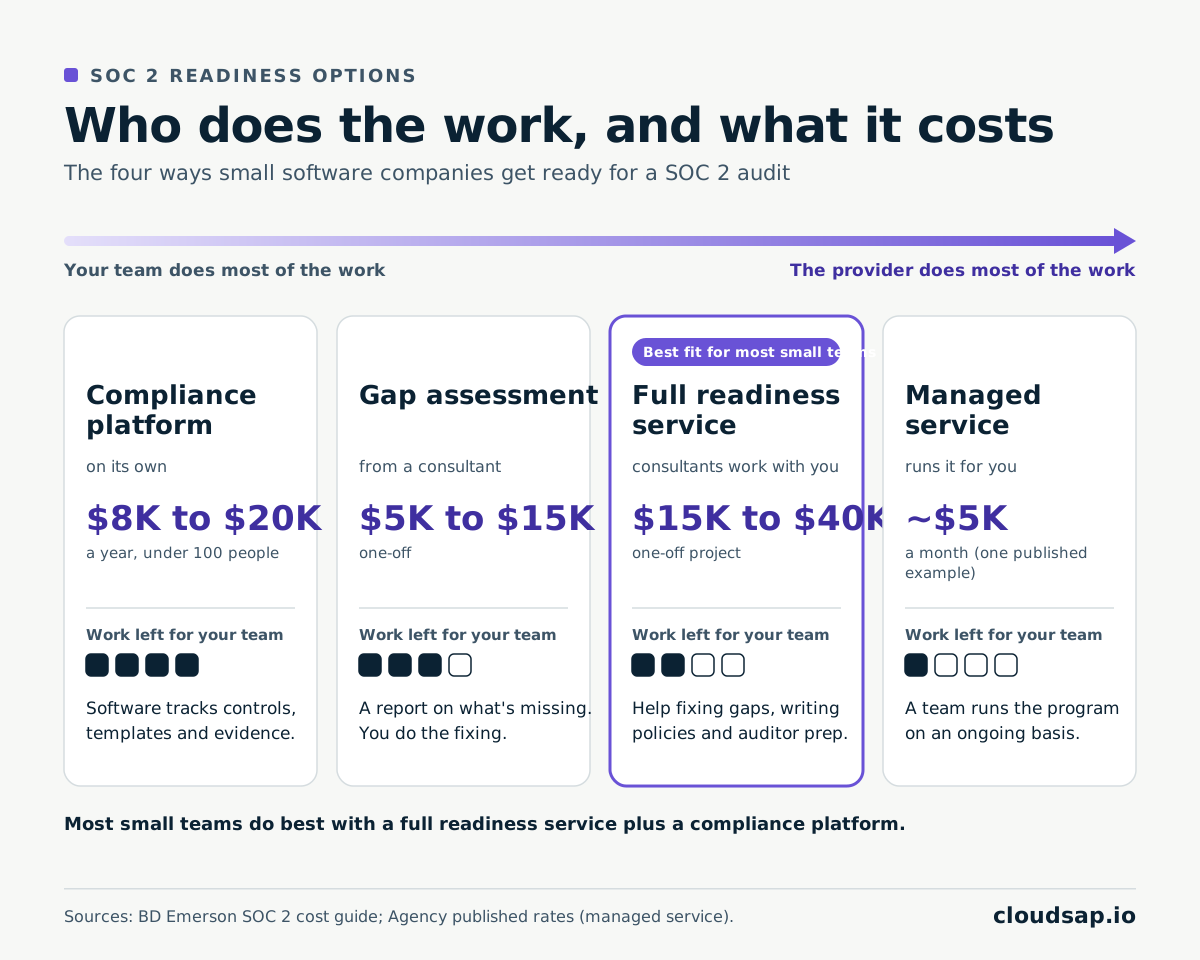
There are four main options. They differ in how much of the work lands on your team:
| Option | What you get | Typical cost | Work left for your team |
|---|---|---|---|
| Compliance platform on its own | Software that tracks controls, provides policy templates and collects evidence | $8,000 to $20,000 a year (under 100 people) | Almost all of it |
| Gap assessment from a consultant | A report on what's missing | $5,000 to $15,000 | All of the fixing |
| Full readiness service | Consultants who help fix gaps, write policies and prep you for the auditor | $15,000 to $40,000 | Technical fixes only |
| Managed compliance service | A team that runs the program for you, usually on a monthly fee | Around $5,000 a month in one published example | Least of all |
The platform and gap assessment prices come from BD Emerson's 2026 cost guide. The managed service example is Agency's published rate for companies with 1 to 100 employees.
A platform on its own looks cheapest, but somebody still has to do the work. At a 20-person company, that's usually the CTO, at 11pm, reading a policy template called "Acceptable Use v3 FINAL."
Which one is best for a small software company?
For most teams under 50 people, a compliance platform plus a full readiness service works best. The platform handles evidence collection, and the readiness team handles the parts software can't: scoping, writing policies that match how you actually work, and getting you ready for the auditor's questions.
You can narrow it down by asking two questions:
- Does someone on your team have time to own this for three months? If yes, a platform plus a gap assessment can work. If your only candidate is a CTO who also runs engineering, hiring and the office Wi-Fi, get more help.
- Is a deal waiting on the report? If a prospect needs it this quarter, pay for a full readiness or managed service. The extra cost is usually small next to the contract.
Doing it all yourself with a platform makes sense if you have someone with security or compliance experience in-house. Without that person, the platform becomes a very expensive to-do list.
What should you look for in a readiness provider?
Ask these questions on the first call:
- Have you prepared companies our size for SOC 2? A provider used to 2,000-person enterprises may build you a program with 40 policies and a steering committee. You have 14 people and a Slack channel.
- Who does the work? Get the name of the person you'll work with, not just the partner who runs the sales call.
- What do you need from my engineers? A good provider can estimate engineering hours up front. "It depends" is fine, but it should be followed by a number.
- Do you work with our compliance platform? If you already pay for Vanta, Drata or similar, the provider should work inside it rather than adding another tool.
- Will you help us choose an auditor? Good providers know which audit firms are a fit for small SaaS companies and which ones your buyers recognise.
- What happens after the audit? SOC 2 renews every year. Ask what ongoing support looks like and what it costs.
What are the red flags?
Be careful if a provider:
- Guarantees you'll pass. Nobody can guarantee an auditor's opinion. They can guarantee you'll be well prepared.
- Offers readiness and the audit as one package with no explanation. Per BD Emerson, the CPA firm that signs your SOC 2 opinion can't also design and build the controls it audits. Some firms keep the two teams separate, which is fine. Ask how they do it.
- Promises a Type II report in a few weeks. A Type II needs an observation window of at least a few months. A fast, believable timeline covers readiness, or a Type I.
- Sends you 30 policy templates and calls it done. Policies your team doesn't follow are worse than none, because the auditor tests whether you follow them.
- Can't give you a price range on the first call. You should get at least a ballpark after one conversation about your size and setup.
FAQs
Is a compliance platform the same as a readiness service? No. A platform is software that tracks controls and collects evidence. A readiness service is people who scope the audit, fix gaps with you and prepare you for the auditor. Many small companies use both.
How long does SOC 2 readiness take? A gap assessment usually takes 6 to 8 weeks. Fixing the gaps adds more time depending on what's missing. With hands-on help, many small teams are ready for a Type I audit or a Type II observation window within a few months.
Can my auditor do the readiness work? The firm that signs your SOC 2 opinion can't design and build the controls it audits. Some firms offer readiness through a separate team. Ask how they keep the two apart.
How much engineering time will readiness take? It depends on your current setup. Expect work on access control, logging, MFA, backups and change management. A good provider will give you an estimate after the gap assessment.
Do we need a readiness service if we already bought Vanta or Drata? Not always. If someone on your team has compliance experience and time, the platform may be enough. If not, a readiness service helps you use the platform you're already paying for.
What's the cheapest option that still works? A compliance platform plus a one-off gap assessment, as long as one person on your team owns the fixes and has time to do them.
Want to know how far you are from audit-ready?
Book a free 45-minute gap analysis with CloudSapio. We'll look at where your controls stand today, tell you which readiness option fits your team and budget, and give you a realistic date you can share with buyers.
Ready to move faster?
Too much to do,
too important to ignore.
Start with a 30-minute discovery call. If we're not the right fit, we'll tell you and point you in the right direction. If we are, we'll leave the call with a clear plan to get you up and running.